







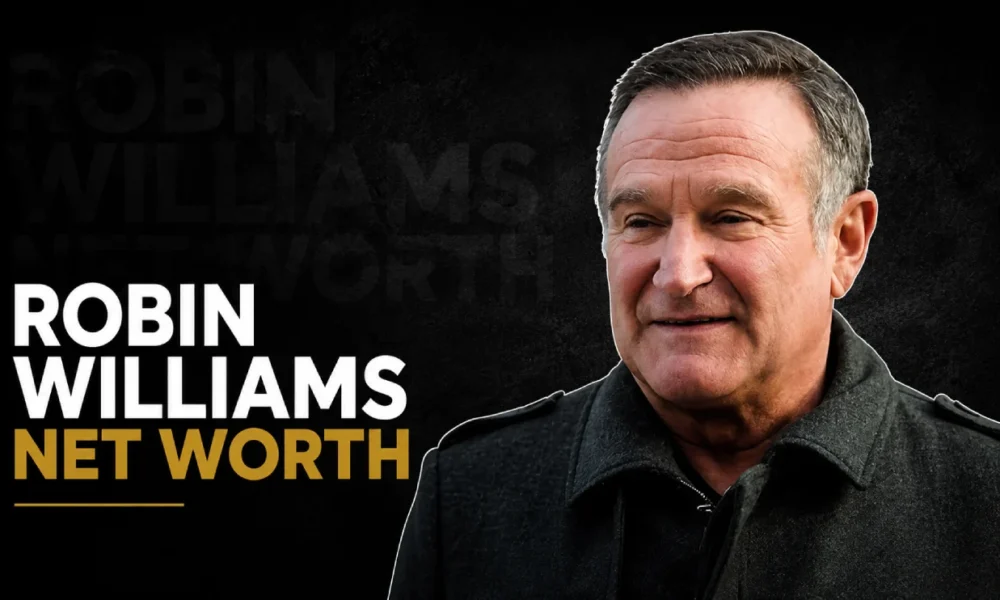
Robin Williams had a net worth of $50 million at the time of his death in August 2014. At his career peak, that figure was estimated at $130 million. His films grossed $3.7 billion at the global box office. Two divorce settlements costing an estimated $30–40 million significantly reduced his wealth over his lifetime.
Table Of Content
An autopsy after his death revealed he had been suffering from Lewy Body Dementia — one of the most severe cases pathologists had ever seen.
Key Takeaways
- Robin Williams had a net worth of $50 million at death and approximately $130 million at his career peak.
- Two divorces cost him an estimated $30–40 million over his lifetime.
- His estate plan restricted commercial use of his name and likeness for 25 years after his death — until at least August 11, 2039.
- He died believing he had Parkinson’s disease. His autopsy revealed advanced Lewy Body Dementia, a condition never identified during his lifetime.
- His case illustrates why LBD is so often misdiagnosed, even in patients with access to excellent medical care.
Few names in entertainment carry as much weight as Robin Williams. He won an Academy Award, two Emmy Awards, six Golden Globe Awards, five Grammy Awards, and two Screen Actors Guild Awards across a career that spanned four decades. He was voted the greatest comic of the 1990s by Entertainment Weekly and received the Cecil B. DeMille Award for lifetime achievement. His genius behind the camera was undeniable. But when it comes to Robin Williams’ net worth, the story behind the numbers is just as compelling as any performance he ever gave.
He earned fortunes, lost significant chunks to divorce, and still left behind an estate worth $50 million when he died on August 11, 2014. He was 63. Understanding his financial legacy means looking beyond a single number. It means tracing the arc of a career that stretched from stand-up stages in San Francisco to Oscar ceremonies in Hollywood — and understanding the neurological disease that shaped his final years in ways the public did not understand until long after he was gone.
This article covers how Williams built his wealth, what reduced it, how much his estate was worth at death, what his fortune looks like in today’s dollars, the Lewy Body Dementia that took his life, and what happened to his money and his legacy after he passed.
Robin Williams Net Worth at the Time of His Death
The $50 Million Figure and What It Means
Robin Williams had a net worth of $50 million at the time of his death. That figure comes from Celebrity Net Worth, one of the most widely cited sources for celebrity financial data. Adjusted for inflation, $50 million in 2014 is equivalent to approximately $66.5 million in 2025 dollars. That still places him among Hollywood’s wealthier actors at the time of his passing.
What makes the number striking is how much larger it could have been. His estate could have been worth considerably more had he not spent $30–40 million during his life on divorce settlements alone. Two marriages ended in divorce. Each one came with a financial cost that quietly eroded a fortune built over decades. A third marriage to Susan Schneider began in 2011 and ended with his death in 2014.
He Was Not Broke — Correcting the Record
Despite public speculation about financial stress in his final years, Robin Williams was absolutely not broke when he died. In a 2013 interview with Parade magazine, he spoke openly about selling his Napa Valley ranch, saying: “There are bills to pay. My life has downsized, in a good way.” That candidness fueled speculation that he was in financial trouble, but the reality was different. He was simplifying his life, not drowning in debt. A $50 million estate is not the picture of a man in financial distress.
How Robin Williams Built His Wealth
Early Career: From Stand-Up Stages to Sitcom Fame
Robin Williams got his start performing stand-up comedy in San Francisco and Los Angeles in the mid-1970s. His break came when he was cast as Mork in the television series Mork & Mindy (1978–1982), which made him a household name almost overnight. His debut comedy album, Reality… What a Concept (1979), won a Grammy Award and established him as one of the most original comedic voices of his generation.
Through the 1980s, Williams transitioned between stand-up, television, and film with a work ethic that was virtually unmatched. He recorded multiple stand-up specials, appeared on talk shows constantly, and began landing leading film roles. Each of those income streams added to a fortune that, at its height, placed him in rare company among Hollywood’s highest earners.
Blockbuster Film Salaries
Williams was not just a beloved performer. He was a box office force. Films in which he was the lead actor grossed $3.7 billion at the global box office. After adjusting for inflation, his films grossed more than $6 billion worldwide. That kind of commercial success gave him enormous leverage in salary negotiations from the late 1980s onward.
| Film | Year | Estimated Salary | Box Office (Global) |
|---|---|---|---|
| Good Morning, Vietnam | 1987 | $3–4 million | $123 million |
| Dead Poets Society | 1989 | $5 million | $235 million |
| Hook | 1991 | $10 million+ | $300 million |
| Aladdin (voice) | 1992 | $75,000* | $504 million |
| Mrs. Doubtfire | 1993 | $15–20 million | $441 million |
| Jumanji | 1995 | $10–15 million | $262 million |
| Good Will Hunting | 1997 | $5 million | $225 million |
| Bicentennial Man | 1999 | $20 million | $87 million |
| Night at the Museum | 2006 | $5–8 million | $574 million |
*Williams earned only $75,000 for Aladdin due to a prior agreement with Disney, despite the film grossing over $500 million. This became one of the most famous salary disputes in Hollywood history.
Voice Work and the Aladdin Dispute
His voice work for Aladdin remains one of the most celebrated performances in animation history — and one of the most underpaid. Williams was bound by a prior agreement with Disney that capped his fee at $75,000, a fraction of what the film earned. The film grossed over $500 million worldwide. Disney’s use of the Genie character in merchandising and promotional material, which Williams had specifically asked them to limit, led to a rift between the actor and the studio that took years to repair.
Stand-Up, Television, and Awards
Beyond film, Williams was a relentless performer. From the early 1980s through the late 1990s, he was starring in television shows, recording stand-up comedy specials, performing in a wide range of movies, hosting awards shows, and appearing on numerous talk shows. His ability to command massive audiences across multiple entertainment formats meant his income was never dependent on a single revenue stream.
His career awards reflect the breadth of his impact:
- Academy Award — Best Supporting Actor for Good Will Hunting (1998)
- 2 Emmy Awards — including Individual Performance in a Variety Program
- 6 Golden Globe Awards — including the Cecil B. DeMille Award for lifetime achievement
- 5 Grammy Awards — including Best Comedy Album
- 2 Screen Actors Guild Awards
Financial Milestones
| Category | Details |
|---|---|
| Peak Net Worth | ~$130 million |
| Net Worth at Death (2014) | $50 million |
| Inflation-Adjusted (2025) | ~$66.5 million |
| Total Box Office (lead films) | $3.7 billion ($6B+ adjusted) |
| Bicentennial Man Salary | $20 million |
| Aladdin Voice Acting Fee | $75,000 (prior Disney agreement) |
| Divorce Costs (estimated) | $30–40 million |
| Tiburon Home (purchased 2008) | $4.05 million |
| Tiburon Home (sold 2020 by Susan) | $5.35 million |
| Napa Valley Villa (sold 2016) | $18.1 million |
| Sea Cliff Mansion (purchased 1991) | $3.2 million |
| Sea Cliff Mansion (sold Jan 2025 by Marsha) | $18.1 million |
What Reduced His Net Worth Over Time
Two Divorces and Their Financial Cost
Robin Williams married three times. He was married to Valerie Velardi from 1978 to 1988. His second marriage to Marsha Garces lasted from 1989 to 2010. His third and final marriage to Susan Schneider began in 2011 and ended with his death in 2014. The first two marriages ended in divorce; the third ended with his passing.
The divorces combined cost him an estimated $30 to $40 million. For context, that amount would have pushed his final net worth closer to $80–90 million had those settlements not occurred. The gap between his $130 million peak and his $50 million final figure is largely explained by these settlements, along with charitable giving, lifestyle costs, and a late-career shift toward lower-budget projects.
The Sea Cliff Mansion: A Case Study in Divorce Assets
The Sea Cliff mansion in San Francisco illustrates how divorce reshapes a celebrity’s asset portfolio. Williams and Marsha Garces purchased the Italian Renaissance-style home in San Francisco’s Sea Cliff neighborhood in 1991 for $3.2 million. The couple took the house down to the studs and rebuilt it in the early 1990s, updating all major systems while preserving the rare building materials from its original 1926 construction. They added a movie theatre, hidden bar, and a secret tunnel connecting their children’s bedrooms.
When the couple divorced in 2010, Marsha kept the property. She lived there for over 30 years before listing it for sale in October 2023 at $25 million. “It’s a beautiful, happy house,” she told Mansion Global. “We had many, many fantastic years of fun and play and joy there.” The home sold on January 23, 2025, for $18.1 million.
Health Struggles and Career Slowdown
Williams was open about his struggles with addiction throughout his career. Those battles affected both his personal life and, at times, his ability to take on higher-paying projects. In his final years, he took on fewer leading roles and shifted toward smaller independent films and sequel appearances in franchise properties like Night at the Museum. The shift from $20-million paydays to smaller projects reflected not a loss of marketability but a neurological decline that limited his capacity to perform at his peak — a fact the public would not understand until after his death.
Lewy Body Dementia: The Disease Behind the Headlines
When Robin Williams died by suicide on August 11, 2014, the world lost one of its most beloved entertainers. For many, the news was devastating but not entirely surprising. Williams had been open about his struggles with depression and addiction throughout his life. It seemed like a tragic end to a long battle with mental illness.
Three months later, the autopsy results told an entirely different story.
What Is Lewy Body Dementia?
Lewy Body Dementia (LBD) is a progressive brain disorder caused by abnormal protein deposits — called Lewy bodies — in areas of the brain that control thinking, memory, movement, and behavior. It is the third most common form of dementia after Alzheimer’s and vascular dementia, affecting an estimated 1.4 million people in the United States. Despite its prevalence, it remains one of the most frequently misdiagnosed neurological conditions.
Robin Williams had one of the most severe cases of diffuse Lewy Body Dementia that pathologists had ever seen. Lewy bodies had spread throughout his brain. The depression, anxiety, and paranoia that consumed his final months were not a return of old demons. They were symptoms of a progressive brain disease that was never identified while he was alive.
The Symptoms No One Connected
In retrospect, Robin Williams showed textbook signs of Lewy Body Dementia for years before his death. The problem was that each symptom, taken individually, seemed to have another explanation.
- Sleep disturbances: Changes in his sleep patterns appeared years before other symptoms became obvious. REM sleep behavior disorder — where people physically act out their dreams — is one of the strongest early predictors of LBD.
- Escalating anxiety: Susan Schneider Williams described her husband’s final-year anxiety as “terror.” The man who had made millions laugh was consumed by fear and paranoia he could not explain. He would sit frozen with anxiety, unable to articulate what he was afraid of.
- Treatment-resistant depression: Robin Williams had experienced depression as a younger man, which made his mood changes in 2013 and 2014 seem like a recurrence of a familiar problem. But this depression was different. Medications that had helped before no longer worked. Depression in LBD is caused by the disease damaging mood-regulating brain circuits, and it often resists standard treatments because the underlying cause is neurodegeneration, not a chemical imbalance that antidepressants can correct.
- Movement symptoms: He developed a tremor in his left hand and experienced stiffness and slowness. His voice, once capable of instantly shifting between dozens of characters and accents, grew softer and less dynamic. His distinctive rapid-fire physicality began to slow.
- Confusion, forgetfulness, and paranoia: Friends, family, and film colleagues could tell he was not himself. He experienced hallucinations, personality changes, and cognitive difficulties that worsened rapidly in his final months.
Misdiagnosis and Rapid Decline
These movement symptoms led doctors to diagnose him with Parkinson’s disease in May 2014, just three months before his death. The diagnosis was understandable. The movement symptoms of LBD and Parkinson’s disease look nearly identical, and many of the cognitive and psychiatric features can be attributed to other causes. Robin Williams died believing he had Parkinson’s disease and depression.
The diagnostic failure is particularly striking because Robin Williams had access to excellent medical care. His decline from early symptoms to death occurred over approximately three years — a rapid progression that, in hindsight, should have raised flags for a Lewy Body diagnosis rather than Parkinson’s alone. His case illustrates why LBD is so often misdiagnosed. The symptoms mimic Parkinson’s disease, psychiatric conditions, and other forms of dementia. Even experienced neurologists can miss it.
“The Terrorist Inside My Husband’s Brain”
Susan Schneider Williams became a powerful advocate for LBD awareness after her husband’s death. She published a detailed account of what Robin experienced in the medical journal Neurology in 2016, providing an intimate and heartbreaking look at how the disease can devastate someone from the inside out, even when the people around them cannot see what is happening.
“Robin is and will always be a larger-than-life spirit who was inside the body of a normal man with a human brain. He just happened to be that one in six who is affected by brain disease.”
— Susan Schneider Williams
Susan has since dedicated herself to raising awareness about LBD through the Lewy Body Dementia Association. Her writing about her husband’s experience has helped countless families recognize symptoms and seek proper diagnosis. She has spoken publicly about the need to treat mental illness and neurological compromise with the same seriousness as any other challenging disease.
Mental illness and being mentally compromised has to be treated as seriously as any other challenging illness. Those who have not experienced a loved one’s neurological decline may mistakenly view it as a choice or a weakness. Robin Williams’ story demonstrates otherwise.
Financial Implications of His Health Decline
While Williams was not in financial distress at the time of his death, his health battles affected his career trajectory in measurable ways. In his final years, he took on lower-budget projects and fewer leading roles. The shift from $20-million paydays to smaller independent films reflected not a loss of marketability but a neurological decline that limited his capacity to perform at his peak. This is an often-overlooked factor in any discussion of his net worth trajectory.
Robin Williams’ Estate Plan and Legacy
Protecting His Children’s Inheritance
Williams was deliberate about what happened to his money after death. He ensured that his trust protected his children’s inheritance from heavy taxation and legal complications. He had three children: Zachary (Zak), Zelda, and Cody. According to People, Williams left his estate to a trust for his three children. His will stipulated that his wife, Susan, be provided for under the terms of their prenuptial agreement.
In February 2015, Williams’ children and his widow went to court in a dispute over the division of personal property, including jewelry and memorabilia. While the dispute was widely covered in the media, it concerned tangible personal items — not the core financial structure of his estate, which remained intact and well-protected.
The 25-Year Publicity Restriction
One of the most significant and forward-thinking parts of his estate plan involves his likeness. According to a review of the Robin Williams Trust filed in court, his estate plan restricts the exploitation of his right of publicity for 25 years after his death. That means there will be no authorized advertisements featuring Robin Williams until at least August 11, 2039.
His heirs cannot strike deals to license or sell his name, voice, signature, or likeness. He left these rights to the Windfall Foundation, a charitable organization set up by his legal representatives at the law firm of Manatt, Phelps. The provision also prevents someone from immediately creating, for example, a hologram of a Robin Williams standup routine or digitally inserting him into a new film.
“It’s interesting that Williams restricted use for 25 years. I haven’t seen that before. I’ve seen restrictions on the types of uses — no Coke commercials for example — but not like this. It could be a privacy issue.”
— Laura Zwicker, estate planning attorney at Greenberg Glusker
In an era where artificial intelligence can now replicate a person’s voice and image with disturbing accuracy, that 25-year restriction looks remarkably prescient. It means no studio can digitally recreate Robin Williams without violating his explicit wishes, at least until the restriction expires in 2039.
The Windfall Foundation and Tax Strategy
Robin Williams’ estate plan was described by legal experts as cutting-edge and potentially a model for other celebrities preparing for their demise. Beyond the 25-year publicity restriction, the structure of his trust reveals sophisticated tax planning.
If the Windfall Foundation is deemed ineligible for a charitable deduction under the Internal Revenue Code, the Trust mandates that Robin Williams’ publicity rights be distributed to one or more qualifying charitable organizations such as Doctors Without Borders, AIDS research organizations, or the Make-a-Wish Foundation.
This structure appears to be a direct response to a dispute between the estate of Michael Jackson and the IRS over how to value a deceased celebrity’s publicity rights for estate tax purposes. The federal government claimed Jackson’s estate owed more than $500 million in taxes from his publicity rights and nearly $200 million more in penalties. The dispute was being adjudicated in U.S. Tax Court at the time Williams’ estate plan was being administered.
By assigning publicity rights to a tax-advantaged charitable organization, Williams both asserted control over posthumous exploitation and limited his family’s potential tax exposure. He recognized that the value of a celebrity’s afterlife had increased significantly in recent years and acted to mitigate the IRS’s interest in his estate. Together, the Michael Jackson case and Robin Williams’ estate plan may have permanently changed the way celebrities approach estate planning.
Robin Williams’ Net Worth Compared to Peers
At his peak, Williams stood among the highest-paid actors in Hollywood. His $130 million peak net worth placed him well above most of his contemporaries in the comedy space, though behind the biggest action stars of the era. The table below shows how his financial trajectory compared to peers who built careers in similar genres and time periods.
| Celebrity | Peak Net Worth (Est.) | Current / At Death | Key Difference |
|---|---|---|---|
| Robin Williams | ~$130 million | $50 million (2014, at death) | Divorce costs, health decline, late-career shift |
| Jim Carrey | ~$180 million | ~$180 million (living) | No comparable divorce erosion |
| Steve Martin | ~$130 million | ~$140 million (living) | Wealth diversified through writing, art, touring |
| Eddie Murphy | ~$200 million | ~$200 million (living) | Sustained blockbuster salary negotiations |
| Bill Murray | ~$180 million | ~$180 million (living) | Selective project approach, real estate investments |
Note: All figures are estimates from public sources including Celebrity Net Worth. They should be treated as approximations, not verified financial disclosures.
What separates Williams from many peers financially is the combination of dramatic salary erosion through divorce, a late-career pivot toward lower-budget films, and the impact of a neurological disease that shortened his career. His final estate, while still substantial, reflects a gap between what he earned over a lifetime and what he retained.
Real Estate Portfolio
Robin Williams owned several notable properties over the course of his life. His real estate portfolio reflected both his success and the financial transitions brought on by divorce and downsizing.
Sea Cliff Mansion, San Francisco
Purchased in 1991 with Marsha Garces for $3.2 million, this Italian Renaissance-style home in San Francisco’s tony Sea Cliff neighborhood was built in 1926. The couple took the house down to the studs and rebuilt it in the early 1990s, updating all major systems while preserving the original architectural details. They added a movie theatre, hidden bar, and a secret tunnel connecting their children’s bedrooms. The home featured views of the Golden Gate Bridge and the Marin Headlands. After their 2010 divorce, Marsha kept the property. She listed it in October 2023 for $25 million, and it sold for $18.1 million on January 23, 2025. Notable Sea Cliff neighbors have included Metallica guitarist Kirk Hammett, Twitter founder Jack Dorsey, and actress Sharon Stone.
Tiburon Estate, Marin County
Williams purchased this 6,517-square-foot Mediterranean contemporary home in Paradise Cay, Tiburon, in 2008 for $4.05 million. With six bedrooms and six-and-a-half bathrooms, the home offered sweeping water views to the Golden Gate Bridge and the Marin Headlands. This was the home where Williams spent his final years and where he died on August 11, 2014. After his death, the property was transferred to a trust tied to his widow, Susan Schneider Williams. She sold the residence in 2020 for $5.35 million, having listed it a year earlier for $7.25 million.
Villa Sorriso, Napa Valley
In 2003, Williams built a five-bedroom mansion in Napa Valley named Villa Sorriso — “Villa of Smile” in Italian. The sprawling estate featured 10 bathrooms, a separate caretaker’s house with four extra bedrooms, space for nine horses, more than 100 olive trees, and a 7.4-hectare vineyard. Additional amenities included a tennis court, library, theatre, wine cellar, infinity edge pool, and hiking and riding trails. A year before his death, Williams was trying to sell the property. “There are bills to pay. My life has downsized, in a good way. I’m selling the ranch up in Napa. I just can’t afford it anymore,” he told Parade magazine in 2013. The estate finally sold in 2016 for $18.1 million.
Conclusion
Robin Williams’ net worth of $50 million at death was the result of spectacular earnings, costly marriages, a devastating neurological disease, and remarkably deliberate estate planning. He entered Hollywood with raw talent and left behind a financial legacy that is more complicated than any single headline suggests.
His films still earn, stand-up specials still sell, and his voice as the Genie still reaches new generations. The 25-year publicity restriction he built into his estate means his name will not be rented out cheaply — no AI recreation, no hologram, no digitally inserted cameo until at least 2039.
What matters most is the gap between the $130 million peak and the $50 million final number. That $80 million gap is a story of real life, not failure. Divorce costs, addiction recovery, health decline from a disease that was never properly diagnosed, and decades of giving to causes he believed in all shaped that outcome. When you look at the full arc of his career and his finances together, what you see is not a cautionary tale. You see a man who earned enormously, lived fully, suffered from a disease no one could name, and still left his children a foundation to stand on.


No Comment! Be the first one.