








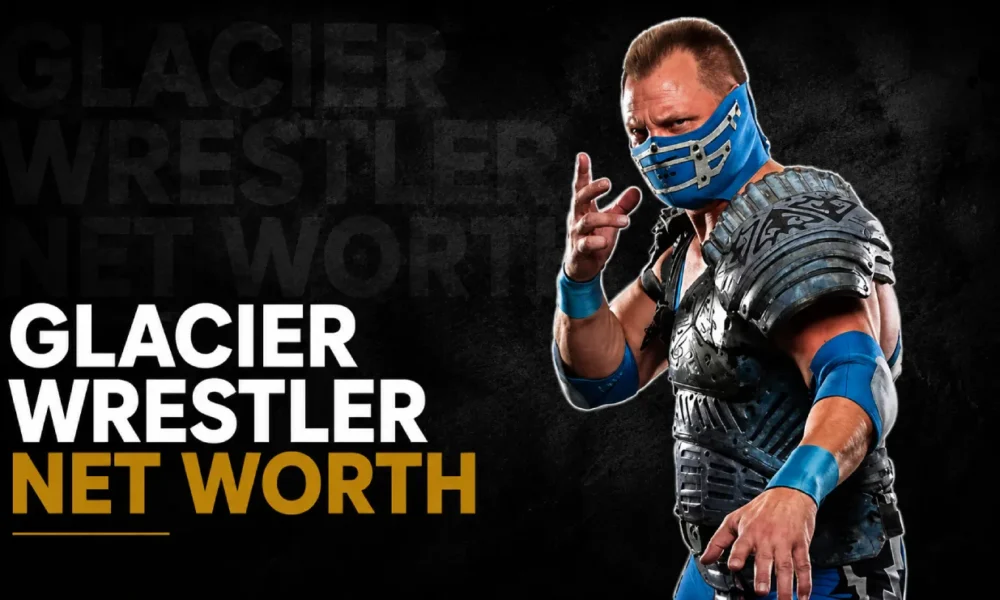
Raymond Lloyd — better known to wrestling fans worldwide as Glacier — is a martial arts champion, college football player, educator, professional wrestler, actor, and coach whose career stretches across nearly four decades. Born into a law-enforcement family in Brunswick, Georgia, Lloyd carved a path from Hung Ga dojos and full-contact karate tournaments to the bright lights of WCW’s Monday Night Wars and, eventually, behind the scenes at All Elite Wrestling. But how has all of that translated into actual wealth?
Table Of Content
- Glacier at a Glance
- Early Life and Family Background
- Martial Arts Career Before Wrestling
- Football and Education
- The Road to Wrestling: Early Career (1987–1996)
- The Japan Chapter: UWFI (1993–1996)
- WCW Career and the Glacier Gimmick (1996–1999)
- After WCW: Championships and Reinvention (2000s)
- How Glacier Earns Money Today
- Career Milestones
- Lifestyle and Financial Management
- Conclusion
Glacier’s estimated net worth is generally placed in the $1 million to $5 million range. That figure reflects not a single windfall but a career of layered, diversified income — from WCW contracts and independent bookings to a co-owned wrestling school, acting credits, and a steady backstage salary at one of wrestling’s two largest promotions.
Glacier at a Glance
| Detail | Info |
|---|---|
| Real Name | Raymond M. Lloyd |
| Ring Name | Glacier |
| Date of Birth | May 13, 1964 |
| Birthplace | Brunswick, Georgia |
| Education | B.A. in Education (1987), M.Ed. (1989) — Valdosta State University |
| Estimated Net Worth | $1 Million – $5 Million (estimated) |
| Primary Income Sources | AEW coaching, training center, acting, independent bookings |
| Active Since | 1987 |
Early Life and Family Background
Raymond M. Lloyd was born on May 13, 1964, in Brunswick, Georgia, into a family rooted in public service. His father, Harold, served as a commander with the Georgia State Patrol for 28 years. His mother, Lois, worked with the Georgia Driver’s License Division before her retirement in 1999. His fraternal twin brother, Ron, followed the family tradition into law enforcement as a retired state trooper.
A lifelong professional wrestling fan, Lloyd and his brother attended shows at the Jacksonville Coliseum as children — an experience that planted the seed for a career that would eventually take him into the same rings he once watched from the stands.
At Brunswick High School, Lloyd played offensive tackle for all four years and became the school’s first-ever All-State football player in his senior year. He also competed for the track and field team in the shot put and discus, showcasing the raw athleticism that would define his career in multiple disciplines.
Martial Arts Career Before Wrestling
Lloyd began studying Hung Ga kung fu at the age of fourteen under a school owned by a former government agent and a U.S. Marshal. He later expanded his training into additional martial arts disciplines, though the school closed to the public in 1982.
In 1983, he entered the World Karate Association’s full-contact tournament circuit. Over the course of his WKA career, Lloyd won the United States Southeastern Super Heavyweight title and compiled an extraordinary record — he was never knocked out or even knocked down. His only career loss came by disqualification.
When the WKA changed its rules in 1985 to allow kicks from the knee up (previously restricted to the waist up), Lloyd chose to retire from competition rather than risk an injury that would jeopardize his football scholarship. That decision reveals something important about his financial mindset even at a young age: he consistently prioritized long-term security over short-term glory.
Football and Education
Lloyd played center at Valdosta State University under coach Mike Cavan and was a teammate of former Atlanta Falcons linebacker Jessie Tuggle during his collegiate career. He graduated in 1987 with a bachelor’s degree in education and completed his master’s degree in education in 1989 — also from Valdosta State.
That combination of physicality, education, and showmanship helped shape not just his in-ring persona but also the business opportunities he would pursue long after the spotlight of WCW faded. Before joining WCW full-time, Lloyd worked as an assistant high school football coach at Lassiter High in Marietta and at Valdosta Junior High School — a safety net and financial discipline that many professional wrestlers simply never develop.
The Road to Wrestling: Early Career (1987–1996)
Lloyd began his wrestling career shortly after graduation, trained by Georgia grappler Fred Avery in a makeshift ring set up in Avery’s backyard. He cut his teeth on the Georgia independent circuit for two years, during which he was given the ring name “Sugar Ray” Lloyd by veteran wrestler Tommy Rich.
During weekends, he worked Southern Championship Wrestling shows while receiving further training from two wrestling legends: Mr. Wrestling II and Bob Armstrong. He moved to Atlanta in 1990 and tag-teamed with Swain as “The Blazers” — named after the Valdosta State athletic mascot. He also competed in the North Georgia Wrestling Alliance alongside future WCW stars Scotty Riggs, Buff Bagwell, and Disco Inferno.
Lloyd’s first taste of World Championship Wrestling came during the 1989 Great American Bash tour, where his debut match was a loss to Butch Reed in Albany, Georgia. He later recalled, “To be in the same ring with a man that big who could move like that was intimidating.”
The Japan Chapter: UWFI (1993–1996)
After a second WCW stint that included being booked against The Great Muta at an Atlanta house show — at Muta’s request, Lloyd joined him on a string of WCW house shows — Lloyd moved to Japan in 1993. He joined the Union of Wrestling Forces International (UWFI) as a guest of celebrated shootfighter Nobuhiko Takada, competing against both Japanese and American fighters in the shoot-style promotion. During his time in the UWFI, he also had the honor of being trained and coached by the legendary Lou Thesz, a former six-time NWA World Heavyweight Champion.
When UWFI folded in 1996, Lloyd returned to the United States. During a conversation with friend Diamond Dallas Page, he mentioned his plan to integrate martial arts into his wrestling — something he had been unable to do during the early days of his career. At Page’s request, WCW president Eric Bischoff, himself a martial arts practitioner, met with Lloyd for three hours and signed him to a contract.
That meeting produced the Glacier character and, with it, the most prominent chapter of Lloyd’s in-ring career.
WCW Career and the Glacier Gimmick (1996–1999)
Blood Runs Cold: The Birth of Glacier
Beginning in April 1996, Lloyd’s new ring persona — Glacier, a gimmick widely noted as inspired by Sub-Zero from the Mortal Kombat video game franchise — was introduced via a series of vignettes during WCW programming featuring the tagline Blood Runs Cold. He was fictionally profiled in the October 1996 issue of WCW Magazine as having traveled to Japan to study a fighting style that combined martial arts and pro wrestling maneuvers, receiving a 400-year-old helmet passed down by his master instructor, David Stater, who gave him the name “Glacier” as a symbolization of the power of the elements.
The Entrance: One of WCW’s Most Expensive Investments
The Glacier character came with one of the most elaborate entrances in professional wrestling history. Blue laser lights streamed across the arena, synthetic snow fell from the ceiling, and the ring was enveloped in blue lighting. Production costs for the entrance alone were reportedly close to half a million dollars, while the costumes and armor were designed by a specialist Atlanta studio.
That level of investment placed the Glacier presentation in rare company alongside entrances for Sting, Goldberg, and the nWo.
In-Ring Results and WCW Salary
Glacier enjoyed a 12-month unbeaten streak during his first year and shared the ring with some of the biggest names in the business, including Hulk Hogan, “Macho Man” Randy Savage, Ric Flair, Bret Hart, Goldberg, and Bobby Heenan. However, he never captured a major WCW championship during his tenure, and by November 1999, he was released as part of a broader cost-cutting wave.
WCW wrestlers during this era earned widely varying salaries:
| WCW Salary Tier | Estimated Annual Range |
|---|---|
| Main eventers (Hogan, Goldberg, Nash) | $1M – $3M+ |
| Upper mid-card | $300K – $700K |
| Mid-card (Glacier’s likely range) | $100K – $300K |
| Lower card/enhancement talent | $50K – $100K |
Glacier’s role as a heavily promoted but non-championship mid-carder likely placed his WCW earnings in the $100K–$300K annual range, though no public contract details have ever been confirmed.
After WCW: Championships and Reinvention (2000s)
After his WCW days, Lloyd teamed with wrestling legend Dusty Rhodes to form Turnbuckle Championship Wrestling (TCW). On this circuit, he won the TCW Heavyweight Championship and the TCW Tag Team titles. On December 28, 2001, he fulfilled a childhood dream by winning the NWA World Tag Team Championship — one of his proudest moments in professional wrestling.
He also worked for Disney in 2004, performing in Indiana Jones stunt shows — reflecting the breadth of his physical performance career beyond the wrestling ring.
How Glacier Earns Money Today
| Income Source | Estimated Annual Range | Status |
|---|---|---|
| AEW coaching/producer salary | $50K – $150K+ | Active (2024–present) |
| One Fall Power Factory (training center) | Varies by enrollment | Active (co-owner) |
| Independent wrestling bookings | $500 – $5,000+ per appearance | Active (occasional) |
| Acting/entertainment work | Union day-rates / flat fees | Active (periodic) |
| Convention appearances | $1,000 – $5,000+ per event | Active |
AEW Coaching and Producer Role
Ray Lloyd currently serves as a coach, trainer, and producer for All Elite Wrestling (AEW) — one of the two largest professional wrestling promotions in the United States. His behind-the-scenes work includes road agent duties and talent development. In addition to coaching, Lloyd has taken on road agent duties at AEW since 2024.
AEW employs multiple experienced wrestlers in similar developmental roles. For example, Angelico has been working as a producer backstage throughout 2025, and Pat Buck serves as a VP who also coaches and works on creative staff — a dual role similar in nature to Lloyd’s contributions. While Lloyd’s specific contract value has not been publicly disclosed, a backstage role at AEW provides steady, recurring income — a meaningful shift from the inconsistent paychecks of independent wrestling.
One Fall Power Factory (Wrestling Training Center)
One of Ray Lloyd’s most significant long-term financial assets is his stake in the One Fall Power Factory, a professional wrestling training center in Atlanta, Georgia, which he co-owns. Wrestling training centers can be meaningful revenue generators when run well — tuition fees per student, private coaching sessions, and weekend seminars all contribute to the income of a well-established school.
In a city like Atlanta — which has long been a hub for professional wrestling — owning a reputable training facility provides both prestige and consistent earnings.
Acting and Entertainment Work
Lloyd’s resume extends into the acting world. He has appeared on television shows such as Burn Notice, The Game, and Tyler Perry’s Meet the Browns, and in feature films including Loaded Dice, Attack of the Morningside Monster, and The Unbreakable Bunch. More recently, he appeared on AEW Dynamite in 2024.
While individual acting credits in television and independent film typically pay union day-rates or flat fees for smaller roles, they demonstrate Lloyd’s ability to diversify earnings across entertainment platforms consistently over many years.
Independent Wrestling and Convention Appearances
Even with a backstage role at AEW, Lloyd has maintained his in-ring presence on the independent circuit. He appeared in AEW’s first-ever Casino Battle Royale match as the Glacier character and continues to compete occasionally. Independent wrestling bookings — particularly for a recognizable name with nostalgia value — can range from a few hundred to several thousand dollars per appearance.
Lloyd also makes convention and fan expo appearances, signing autographs and meeting fans — a revenue stream that has become increasingly common and lucrative for wrestlers with name recognition from the 1990s boom period.
Career Milestones
| Year | Milestone |
|---|---|
| 1964 | Born in Brunswick, Georgia |
| ~1978 | Begins studying Hung Ga kung fu at age 14 |
| 1982 | Graduates Brunswick High School (first All-State football player) |
| 1983 | Begins WKA full-contact tournament career |
| ~1984 | Wins WKA Southeastern Super Heavyweight title |
| 1985 | Retires from karate competition to protect football scholarship |
| 1987 | Begins pro wrestling training under Fred Avery; graduates Valdosta State with B.A. in Education |
| 1989 | WCW debut at Great American Bash (loss to Butch Reed); earns M.Ed. from Valdosta State |
| 1990 | Moves to Atlanta; forms “The Blazers” tag team |
| 1993–1996 | Competes in UWFI (Japan); trained by Lou Thesz |
| 1996 | Returns to U.S.; signs WCW contract after meeting with Eric Bischoff; Glacier character debuts via “Blood Runs Cold” vignettes |
| 1996–1997 | 12-month unbeaten streak as Glacier |
| 1999 | Released from WCW |
| 2001 | Wins NWA World Tag Team Championship (December 28) |
| 2004 | Disney stunt work (Indiana Jones shows) |
| 2019 | Appears in AEW’s first Casino Battle Royale |
| 2024–present | Coach, trainer, and producer at AEW |
Lifestyle and Financial Management
Ray Lloyd is not among the flashiest figures in professional wrestling’s financial landscape. There are no publicly reported stories of major asset purchases, luxury spending, or financial distress associated with Lloyd. His career arc suggests a man who managed his finances with discipline — diversifying early, building a business (the training center), pursuing steady entertainment work, and transitioning into a salaried backstage role before the independent wrestling circuit began to slow down.
His home base remains in Atlanta, Georgia, which is consistent with his training center operations and his AEW coaching responsibilities. That his master’s degree in education also provided a fallback career — high school and middle school coaching — reflects a financial safety net that many professional wrestlers of his era simply never had.
Conclusion
Glacier — Ray Lloyd — is not a centimillionaire like some of wrestling’s biggest names. He is not Hulk Hogan with a multi-million-dollar fortune, nor Triple H with an executive’s equity stake in WWE. But he represents something genuinely valuable in the wrestling business: longevity.
Over nearly four decades, Lloyd has earned income from competitive martial arts, college football, independent wrestling, a WCW contract, a UWFI run in Japan, NWA championship work, a co-owned training facility, acting credits, Disney stunt work, convention appearances, and now a backstage role with one of the two largest wrestling promotions on the planet.
His estimated net worth in the $1 million to $5 million range is a realistic reflection of a career spent building multiple, modest-but-consistent income streams rather than chasing a single windfall. For a performer who was never positioned as a main event star, that is a financially respectable outcome — and one that continues to grow through his work with AEW.

No Comment! Be the first one.