







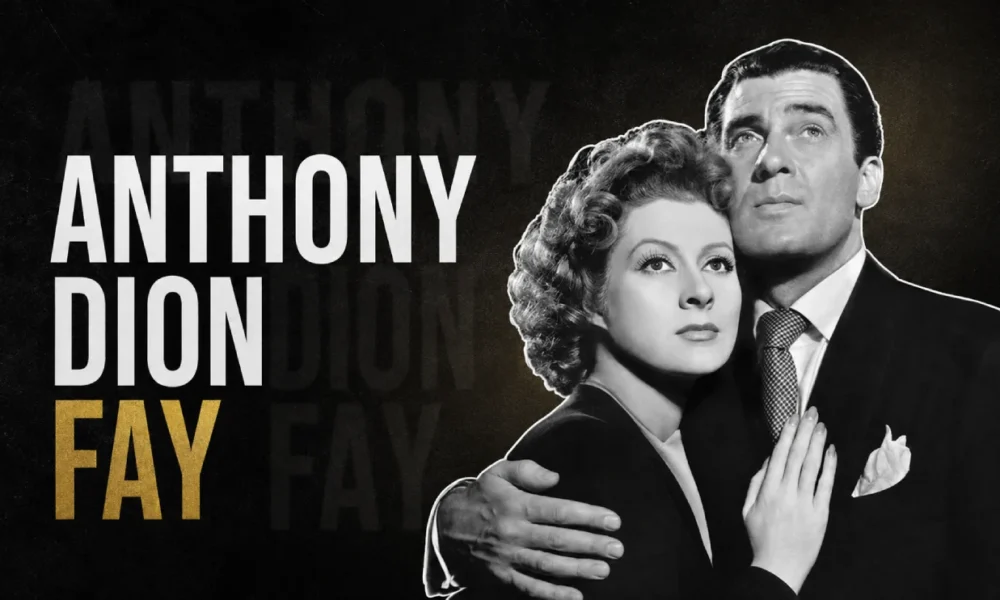
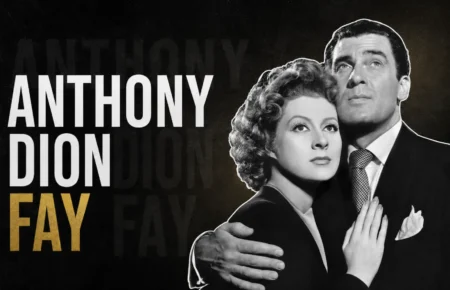
Anthony Dion Fay was born John Charles Greene in Los Angeles on February 5, 1932. He was adopted as an infant by actress Barbara Stanwyck and comedian Frank Fay, renamed, and folded into a Hollywood marriage that was already collapsing. He spent the rest of his life carrying a name that connected him to one of the most celebrated — and emotionally guarded — actresses in American cinema.
Table Of Content
- At a Glance
- The Adoption — and Why It Happened
- Frank Fay, the Swimming Pool, and the End of the Marriage
- Robert Taylor — The Stepfather Who Tried
- Hospitalized at Twelve — When His Mother Didn’t Call Back
- Military School and the Final Estrangement
- Dion’s Own Words — The 1960 Interview
- The Adult Life Almost No One Documented
- The Will: $5,000 From a $10 Million Estate
- What Victoria Wilson’s Biography Actually Tells Us
- Anthony Dion Fay’s Death in 2006
- The Bigger Picture — What This Story Is Actually About
- Conclusion
When Stanwyck died in 1990, her reported estate totaled approximately $10 million. Her only child received $5,000.
But the inheritance is not the most revealing part of this story. In 1960, Dion gave a rare interview in which he spoke about his mother with surprising tenderness — and placed much of the blame for their estrangement on himself. That single interview complicates every simple narrative about a famous mother who abandoned her son.
This is the full account of who Anthony Dion Fay was, what happened between him and his mother, and what his life actually looked like beyond the headlines.
At a Glance
| Detail | Information |
|---|---|
| Birth Name | John Charles Greene |
| Adoptive Name | Anthony Dion Fay |
| Date of Birth | February 5, 1932 |
| Birthplace | Los Angeles, California |
| Adoptive Parents | Barbara Stanwyck and Frank Fay |
| Age at Adoption | Approximately 5 months old |
| Stepfather | Robert Taylor (1939–1951) |
| Date of Death | May 17, 2006 |
| Age at Death | 74 |
| Place of Death | Van Nuys, California |
The Adoption — and Why It Happened
Stanwyck and Frank Fay adopted Dion when he was approximately five months old. The adoption was covered by the press in the way celebrity domesticity always was in early Hollywood — photographs, warmth, the performance of family life.
The reason they pursued adoption rather than having biological children is addressed directly in Victoria Wilson’s A Life of Barbara Stanwyck: Steel-True (2013), the most thoroughly researched biography of the actress. According to Wilson, Stanwyck had undergone a botched abortion at age 15 — a consequence of a largely unsupervised, impoverished childhood in Brooklyn — that left her unable to conceive. Adoption wasn’t a lifestyle choice. It was the only path available to her.
Stanwyck herself had been abandoned by her own parents. Orphaned by the age of four and cycled through foster homes, she never had a model for what stable, present parenting looked like. That absence would shape everything that followed — not as an excuse, but as context.
That context matters. It explains the adoption. It says nothing about what kind of mother she would become.
Frank Fay, the Swimming Pool, and the End of the Marriage
Frank Fay was not a minor figure. He was an established Broadway comedian who had made a successful transition to early Hollywood — and for a time, he was significantly more famous than his wife. As Stanwyck’s career accelerated and his declined, his alcoholism worsened.
The most reported incident from Dion’s early childhood involves Fay drunkenly tossing the young boy into a swimming pool. The incident is consistently cited as a breaking point. Stanwyck filed for divorce in 1935, reportedly motivated in part by the need to protect Dion from his father’s behavior.
A bitter custody battle followed. Frank Fay fought for custody of Dion — but by the end of the proceedings, he had allegedly lost interest in the boy. What happened to Dion in the years immediately after the divorce is not well documented in publicly available sources.
What is clear is that the home Dion grew up in — photographed for fan magazines as a picture of Hollywood family life — was, in private, unstable and at times dangerous.
Robert Taylor — The Stepfather Who Tried
In 1939, Stanwyck married actor Robert Taylor. The relationship was widely covered and glamorous by any measure. For Dion, it initially seemed like another sign of his marginal place in his mother’s life — he was not Taylor’s biological child, and the new marriage consumed much of Stanwyck’s attention.
But the picture was more complicated than it first appears. According to accounts of the household, Taylor didn’t fully approve of Stanwyck’s approach to raising Dion. He reportedly tried to connect with the boy and occasionally defended him from his mother. Taylor’s own assessment of Dion was measured: he wasn’t a “bad kid,” but he did get bad grades.
That characterization — not a bad kid, just a struggling one — is a small but important detail. It suggests that at least one adult in Dion’s life saw him clearly, even if the household as a whole couldn’t provide what he needed.
Stanwyck and Taylor divorced in 1951. By then, Dion was 19 years old, and the emotional distance between him and his mother had long been established.
Hospitalized at Twelve — When His Mother Didn’t Call Back
When Dion was twelve, he suffered a severe injury at summer camp and was hospitalized. Doctors tried to reach his mother. She never came to see him. She didn’t return the doctors’ calls.
The person who showed up, and who continued to show up during Dion’s difficult adolescence, was his Uncle Buck. By multiple accounts, Buck was the one adult in Dion’s life who offered consistent care and attention — the kind of steady presence that Stanwyck, for all her professional discipline, could not or would not provide.
The summer camp hospitalization is not a minor anecdote. It marks a turning point: the moment when a child’s need was met with silence from the one person whose response mattered most. Everything that followed — the delinquency, the estrangement, the decades of distance — traces back, at least in part, to moments like this one.
Military School and the Final Estrangement
As Dion’s behavior deteriorated through early adolescence, Stanwyck and Robert Taylor sat him down to discuss his future. One account suggests that Dion’s weight — he was reportedly “plump,” and Stanwyck didn’t like that — was among the factors in her decision. He was sent to a military school in Indiana.
After that, he never saw his mother again. Not for holidays. Not for birthdays. Not for years.
The single exception: a brief lunch in 1952, arranged by his Uncle Buck. It was the last time mother and son were in the same room.
Dion was roughly twenty years old. Stanwyck was in the middle of some of the most productive years of her career. The distance between them would never close.
Dion’s Own Words — The 1960 Interview
In 1960, Anthony Dion Fay did something he would never do again: he spoke publicly about his mother.
In the interview, he described himself as a lousy student who never cared much for his education. He understood that Stanwyck hadn’t expected him to “be a genius,” but she had wanted him to take advantage of his schooling opportunities. He later discovered that she had been willing to send him to any college he chose — a fact he learned too late.
What he said next is the most important sentence in this entire story:
“I’m sorry now that I didn’t take advantage of the offer. I guess it was more my fault than it was hers. How we each went our separate ways.”
Read that carefully. This is not a man lashing out at a neglectful parent. This is a man taking responsibility for a relationship that failed — and expressing genuine regret. He could have blamed her. He had plenty of material. Instead, he pointed the finger at himself.
Whether that self-blame was fair is another question entirely. A twelve-year-old boy whose mother won’t return a hospital call is not responsible for the distance that follows. But Dion chose grace over grievance. That choice says more about his character than any inheritance figure ever could.
The Adult Life Almost No One Documented
This is where the public record thins out — and it’s worth being direct about that rather than papering over it.
What is known: Dion eventually settled in the San Fernando Valley area of Los Angeles. He worked in modest employment — accounts indicate he worked in a motel for a period — far from the entertainment industry that had defined his mother’s life. He reportedly married and had a son, though details about his family life have remained private.
At some point in the mid-to-late 1950s, Dion was arrested for attempting to sell obscene photographs while cashing an unemployment check. The exact date is disputed — sources cite either 1957 or 1960 — and has never been authoritatively resolved. What the incident indicates clearly: he was struggling financially, without a reliable safety net, at a time when his mother was one of Hollywood’s highest-earning performers.
Victoria Wilson, who interviewed Dion directly over several sessions while researching her biography, described him as a warm and loving man who had found a measure of peace despite a genuinely difficult life. That characterization carries weight — it comes from someone who knew him personally, not from secondhand speculation.
But Wilson’s biography also makes clear that Stanwyck’s emotional unavailability toward her son was not a temporary phase. It was a consistent feature of his life from childhood onward.
The Will: $5,000 From a $10 Million Estate
Barbara Stanwyck died on January 20, 1990, from congestive heart failure. She was 82. Per her instructions, there was no funeral service. Her ashes were scattered from a helicopter over Lone Pine, California — the Eastern Sierra landscape where she had filmed several of her Westerns.
Her reported estate: approximately $10 million.
Her only child’s inheritance: $5,000.
| Aspect | Detail |
|---|---|
| Total estate value | Approximately $10 million |
| Inheritance to Dion | $5,000 |
| Dion’s share | 0.05% of the estate |
| Reported beneficiaries | Friends, charities, household staff |
| Reported condition | Dion must never speak publicly about his mother |
Multiple sources have reported that this sum came with a condition — that Dion never speak publicly about his mother. The exact legal language of this stipulation has not been widely published, and it should be treated as reported rather than confirmed. But if accurate, the arrangement is striking: it’s not just a small inheritance. It’s a financial transaction explicitly designed to buy silence.
There is no public record of Anthony Dion Fay ever condemning his mother, selling his story, or attempting to profit from his relationship with her. Whether that was because of a legal condition, personal principle, or simply the quiet way he lived his life — the result was the same. He kept his peace.
What Victoria Wilson’s Biography Actually Tells Us
A Life of Barbara Stanwyck: Steel-True (2013) is the most authoritative source on this story. Wilson — an editor at Alfred A. Knopf for over five decades — spent approximately 30 years researching the biography, earning unprecedented access to Stanwyck’s friends and family through what colleagues described as her professionalism and sensitivity.
Wilson interviewed Dion directly — over multiple sessions, before his death — in a way no other researcher has documented. Her portrait of him is sympathetic and specific: a man who had made peace with a past that offered him very little. Not bitter. Not broken. Someone who had built something decent out of genuinely difficult material.
Wilson’s biography is also the clearest source on Stanwyck’s emotional unavailability as a parent — not as tabloid speculation, but as a documented pattern across Dion’s life from childhood onward. The book covers the first four decades of Stanwyck’s life (1907–1940) in exhaustive detail, and a second volume covering the remainder of her life was anticipated but has not yet been published as of this writing.
Anthony Dion Fay’s Death in 2006
Anthony Dion Fay died on May 17, 2006, in Van Nuys, California. He was 74 years old. He outlived his mother by sixteen years.
There was no notable obituary. No entertainment media coverage. No public memorial.
He was born John Charles Greene. He died as Anthony Dion Fay — the name two famous people gave him when he had no say in the matter. What he made of the decades between those two facts is known primarily through what Victoria Wilson recorded before he was gone, and through the few words he chose to share in that single 1960 interview.
The Bigger Picture — What This Story Is Actually About
The story of Anthony Dion Fay is often framed as a cautionary tale about celebrity parenting — the famous mother who neglected her child, the inheritance that proved her indifference. That framing is not wrong, but it’s incomplete.
There is a generational pattern here that deserves attention. Stanwyck was orphaned at four, raised in foster homes, and left to fend for herself as a teenager. She never learned what stable, present parenting looked like because she never experienced it. Dion was then adopted into a household defined by his adoptive father’s alcoholism, his mother’s emotional guardedness, and the revolving door of marriages that followed. The cycle didn’t repeat exactly — but the emotional deprivation echoed across both lives.
What makes Dion’s story different from the standard Hollywood tragedy is his own response to it. He could have written a tell-all. He could have sold interviews. He could have become the bitter son who made a career out of his famous mother’s failures. He didn’t. Even in his 1960 interview — the one time he spoke publicly — he chose to take responsibility rather than assign blame.
That silence wasn’t weakness. It was a decision. And it’s the most revealing thing about the man.
Conclusion
The story of Anthony Dion Fay doesn’t have a tidy resolution. There was no reconciliation, no apology, no moment where the gap between mother and son closed into something warmer.
What it has are his own words, spoken once and never repeated:
“I’m sorry now that I didn’t take advantage of the offer. I guess it was more my fault than it was hers. How we each went our separate ways.”
Barbara Stanwyck was an extraordinary actress and, by most accounts, a complicated and emotionally withholding person. Both things are true simultaneously. The story of her son doesn’t erase her work. But it is part of her full story — and it deserves to be told without flinching.

No Comment! Be the first one.