







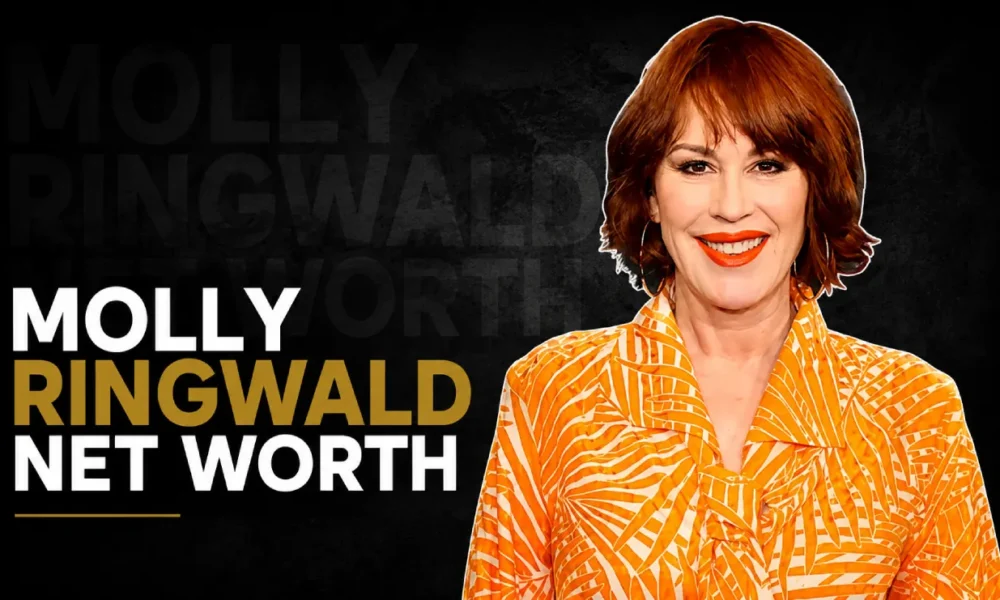
Molly Ringwald has an estimated net worth of $11 million to $13 million in 2025. The actress who defined 1980s teen cinema through Sixteen Candles, The Breakfast Club, and Pretty in Pink has built her wealth across more than four decades of film, television, writing, music, and real estate — not through any single blockbuster payday, but through steady, deliberate work in an industry that often rewards flash over longevity.
Table Of Content
- At a Glance
- How Molly Ringwald Built Her Wealth
- Molly Ringwald vs. The Brat Pack — Net Worth Comparison
- The Pretty Woman Decision — Quantifying the Opportunity Cost
- Why Isn’t Molly Ringwald Worth More?
- Molly Ringwald’s Personal Life — Family and Home Base
- What Is Molly Ringwald Doing Now?
- Conclusion
For someone whose face launched a cultural movement, the number surprises people. Here is how she earned it, where it sits today, and why the gap between her cultural icon status and her net worth tells a more interesting story than the number alone.
At a Glance
| Detail | Information |
|---|---|
| Full Name | Molly Kathleen Ringwald |
| Date of Birth | February 18, 1968 |
| Birthplace | Roseville, California |
| Estimated Net Worth (2025) | $11 million – $13 million |
| Primary Income Sources | Film, television, writing, music, real estate |
| Real Estate Holdings | ~$7.3 million |
| Residence | Santa Monica, California |
| Spouse | Panio Gianopoulos (m. 2007) |
| Children | 3 |
Molly Ringwald is not among the wealthiest actresses in Hollywood, but that number reflects four decades of continuous work across multiple industries — and a deliberate choice to prioritize artistic fulfillment over blockbuster paychecks.
How Molly Ringwald Built Her Wealth
Ringwald’s wealth is not the product of one giant windfall. It has been built steadily, across multiple income streams, over a career spanning more than 40 years.
1980s Film Salaries — The John Hughes Era
The early years were, financially, her biggest. The John Hughes trilogy — Sixteen Candles (1984), The Breakfast Club (1985), and Pretty in Pink (1986) — transformed her from a working child actress into a bona fide star and one of the most recognizable faces in American cinema.
| Film | Year | Role | Reported Salary | Inflation-Adjusted (2025) |
|---|---|---|---|---|
| Sixteen Candles | 1984 | Samantha Baker | ~$250,000 | ~$750,000 |
| The Breakfast Club | 1985 | Claire Standish | ~$500,000 | ~$1.4 million |
| Pretty in Pink | 1986 | Andie Walsh | Reported higher than Breakfast Club | — |
These films were not just cultural landmarks — they became evergreen catalog titles. Streaming platforms have kept them in constant rotation, meaning Ringwald continues to earn passive income from work she completed nearly 40 years ago. Her co-star John Kapelos has confirmed that the main cast of The Breakfast Club still collects royalties to this day.
Television — Steady Paychecks and Career Resurgence
After the 1980s, television became Ringwald’s most consistent income driver. Her television career includes a long list of roles that provided sustained earnings over the decades:
- The Stand (1994) — ABC miniseries, role of Frannie Goldsmith
- Townies (1996) — ABC sitcom, role of Carrie Donovan
- The Secret Life of the American Teenager (2008–2013) — Five-season run as Anne Juergens on ABC Family; one of her longest-running roles
- Raising Expectations (2016–2018) — Family Channel series, role of Paige Wayney
- Riverdale (2017–2023) — Recurring role as Mary Andrews across 36 episodes over the show’s seven-season run on The CW
Beyond these anchor roles, she appeared in Netflix’s The Kissing Booth trilogy (2018–2021), Ryan Murphy’s Monster: The Jeffrey Dahmer Story (2022), and the FX series Feud: Capote vs. The Swans (2024). She was arguably unrecognizable in Monster, playing serial killer Jeffrey Dahmer’s stepmother Shari — a role she loved precisely because audiences did not immediately recognize her.
Each project adds both a paycheck and renewed visibility, keeping her relevant across generations of viewers.
Streaming Residuals — The Gift That Keeps Paying
The 2023 SAG-AFTRA strike fundamentally changed how actors earn from streaming platforms. Under the new contract, performers on legacy content — including 1980s catalog titles — now receive residual payments tied to platform subscriber counts rather than flat buyout fees.
For Ringwald, whose 1980s films remain in constant rotation on platforms like Netflix, Peacock, and Amazon Prime Video, this represents a meaningful improvement in passive income. While exact figures are not publicly disclosed, industry estimates suggest that established performers with catalog titles on major platforms can earn between $50,000 and $200,000 annually in streaming residuals alone.
What Are Residuals? Residuals are compensation paid to actors, writers, and other creatives each time their work is rebroadcast, streamed, or distributed beyond its original release. For legacy performers like Ringwald, residuals from iconic 1980s films generate ongoing passive income decades after the original production.
Every time a new generation discovers The Breakfast Club on a streaming platform, her royalties tick upward. The enduring pull of 1980s intellectual property and the nostalgia economy have made these catalog titles more financially valuable today than at any point since their original theatrical runs.
Writing, Music, and Cultural Commentary
Ringwald’s creative output extends well beyond acting:
- Getting the Pretty Back (2010) — Memoir exploring love, style, and self-confidence
- When It Happens to You (2012) — A linked-story novel exploring the complexities of modern love and marriage
- The New Yorker essays — Her 2018 essay “What About ‘The Breakfast Club’?” revisited John Hughes’s legacy through a modern cultural lens and went viral, generating widespread media discussion
- French literature translation — She has worked as a translator, reflecting her years living in Paris
- Except Sometimes (2013) — Jazz album released through Concord Records, reaching number 7 on the Billboard Jazz Albums chart and number 21 on the Heatseekers chart
Her father was a blind jazz pianist, and she recorded her first album at age six, so music has always been part of her identity. These creative ventures generate book royalties, speaking engagements, performance fees, and press appearances that keep her profile active.
Real Estate Portfolio
Property has played a meaningful role in Ringwald’s financial story. Her real estate portfolio is valued at approximately $7.3 million.
| Property | Action | Year | Price |
|---|---|---|---|
| Mulholland Drive mansion, Los Angeles | Sold to Drew Carey | 1996 | Not publicly disclosed |
| East Village duplex co-op, 122 East 10th Street, New York | Purchased | 2004 | Not publicly disclosed |
| East Village duplex co-op, 122 East 10th Street, New York | Listed for sale | 2016 | ~$1.8 million |
| East Village duplex (same property, resold by new owner) | Resold | 2023 | $7.9 million |
The East Village property was located in a historic townhouse along the Renwick Triangle in the St. Mark’s Historic District. These Anglo-Italianate houses were designed by architect James Renwick Jr. in 1861, and the duplex featured ten-foot exposed beam ceilings, antique wood windows, and two wood-burning fireplaces. Ringwald had used it as a pied-à-terre since her family was based in Santa Monica.
The fact that the property resold for $7.9 million in 2023 — more than four times what Ringwald listed it for in 2016 — suggests she sold before a significant market appreciation. It is one of those financial moments where timing matters as much as strategy.
Molly Ringwald vs. The Brat Pack — Net Worth Comparison
Ringwald sits in the middle of her contemporaries financially. Here is how she compares to fellow Brat Pack members as of 2025:
| Actor | Estimated Net Worth (2025) | Best-Known Role | Current Status |
|---|---|---|---|
| Demi Moore | ~$200 million | St. Elmo’s Fire, Ghost | Acting, producing, memoir Inside Out became a bestseller |
| Rob Lowe | ~$100 million | St. Elmo’s Fire, The Outsiders | Acting, podcasting, hosting, brand partnerships; 9-1-1: Lone Star |
| Emilio Estevez | ~$15–20 million | The Breakfast Club, The Mighty Ducks | Selective projects, directing, owns and operates a vineyard |
| Andrew McCarthy | ~$12 million | St. Elmo’s Fire, Pretty in Pink | Directing, writing; directed the 2024 documentary Brats |
| Molly Ringwald | ~$11–13 million | Sixteen Candles, The Breakfast Club | Active in film, TV, writing, and music |
| Judd Nelson | ~$4 million | The Breakfast Club, St. Elmo’s Fire | Steady work in TV, film, and voice acting |
| Ally Sheedy | ~$4 million | The Breakfast Club, St. Elmo’s Fire | Teaching, selective independent film roles |
| Anthony Michael Hall | ~$4 million | Sixteen Candles, The Breakfast Club | Steady TV work; appeared in Wednesday and Reacher |
Ringwald’s position reflects her particular path: more consistent output than some peers, but less commercial maximization than others. Unlike Rob Lowe, who successfully reinvented himself through network television and brand partnerships to build a $100 million fortune, Ringwald has spread her income across more diverse but individually smaller streams. She is not the wealthiest Brat Pack alum, but she is far from the least — and arguably the most creatively versatile.
Recently, Rob Lowe revealed that the Brat Pack still keeps in touch and is even exploring the idea of a St. Elmo’s Fire sequel. Whether or not a reunion materializes, it speaks to the enduring cultural and financial value of the Brat Pack brand.
The Pretty Woman Decision — Quantifying the Opportunity Cost
In the late 1980s, Ringwald was offered the lead role in Pretty Woman — a part that went to Julia Roberts and generated over $460 million at the global box office, launching Roberts into a career that would yield an estimated net worth of $250 million.
Ringwald has never expressed public regret about the decision. She moved to Paris, took roles in smaller European productions, and pursued literary translation and jazz. The financial opportunity cost is enormous — but so is the creative freedom she gained.
It remains one of Hollywood’s most discussed “what if” scenarios, and a defining lens through which to understand her financial trajectory. She chose artistic exploration over commercial acceleration, and the numbers reflect that trade-off — but so does the breadth and originality of her body of work.
Why Isn’t Molly Ringwald Worth More?
This is the question many people arrive at when they search her name. For someone so culturally iconic, $11–$13 million might seem modest. There are several reasons the number looks the way it does:
- 1980s pay structures were different. Even $500,000 for The Breakfast Club pales beside what a comparable star would earn today. There were no backend points, no streaming residuals built into contracts the way they exist now.
- She left Hollywood at her peak. Ringwald moved to France shortly after her 1980s rise, stepping away from the high-profile projects that build financial momentum. The Paris years were creatively rich but commercially quieter.
- She consistently chose art over commerce. Broadway productions, literary translations, jazz albums, and independent films do not generate the same income as franchise roles or reality television. That has been a deliberate trade-off.
- She turned down Pretty Woman. The role that made Julia Roberts a $250-million icon went elsewhere. The opportunity cost alone accounts for a significant portion of the gap between Ringwald’s cultural stature and her net worth.
- Early residual structures were unfavorable. Actors in the 1980s did not benefit from the streaming residual agreements that exist today. Decades of potential income were lost to contracts that did not anticipate the digital era.
Her balance of cultural relevance and financial prudence — few controversies, no public distress, steady creative output — has yielded a portfolio built for consistency rather than headlines.
Molly Ringwald’s Personal Life — Family and Home Base
Ringwald has been married twice. Her first marriage was to French writer Valéry Lameignère in 1999; the couple divorced in 2002. She married Panio Gianopoulos, a Greek-American writer and editor, in 2007. The couple has three children and lives in Santa Monica, California.
Her eldest daughter, Mathilda Gianopoulos, is following in her mother’s footsteps by pursuing acting. Mathilda’s first screen role was in the global hit romantic comedy The Idea of You, starring Nicholas Galitzine.
The family has a strong connection to Greece, taking annual vacations there — a tradition that reflects Panio’s Greek heritage. Ringwald’s role in the 1982 film Tempest, which earned her a Golden Globe nomination, was her first major film role and, fittingly, has a Greek connection as well.
Ringwald’s lifestyle reflects someone comfortable, not extravagant. There are no reports of lavish spending, public financial distress, or high-profile money controversies. Her assets are anchored primarily in real estate, with ongoing income from residuals, royalties, and active work.
What Is Molly Ringwald Doing Now?
Ringwald remains active across multiple creative disciplines. Her recent and upcoming work signals no signs of slowing down:
- Film and television — She has multiple projects in development and continues to take selective, high-quality roles that prioritize creative challenge over paycheck size
- Cultural commentary — Her viral 2018 New Yorker essay reassessing the John Hughes filmography through a modern lens established her as an articulate cultural critic, not just a nostalgic figure
- Writing — She continues to write essays and contribute to literary conversations
- Music — Jazz performance remains part of her identity and her income
- Family life — She maintains a relatively private life in Santa Monica with her husband and three children
The streaming economy has given her 1980s catalog a second, third, and fourth life with new audiences. The nostalgia economy for 1980s intellectual property continues to grow, and the improved streaming residual structures from the 2023 SAG-AFTRA agreement mean that her classic films are more financially valuable today than at any point since their original release.
Conclusion
Molly Ringwald’s net worth of $11–13 million tells the story of an artist who consistently chose creative integrity over commercial acceleration. From $250,000 and $500,000 paydays in 1980s John Hughes films to steady television income, improved streaming residuals, literary ventures, jazz performances, and a real estate portfolio worth over $7 million, she has built durable wealth across four decades.
The Pretty Woman decision, the Paris years, and the preference for jazz albums over franchise roles all limited her earning potential in conventional terms. But in an era when the 2023 SAG-AFTRA streaming deal has given legacy actors renewed income from their catalogs — and when 1980s nostalgia keeps her most iconic work perpetually in demand — Ringwald’s financial foundation looks more secure than the raw number might suggest.
Her career is a case study in sustainable wealth-building through artistic diversification. The numbers may not rival the biggest names in Hollywood, but few careers have been as genuine, as diverse, or as lasting. And in an industry where fortunes can vanish as fast as they are made, that kind of steady, multi-decade wealth accumulation is its own kind of success story.


No Comment! Be the first one.