









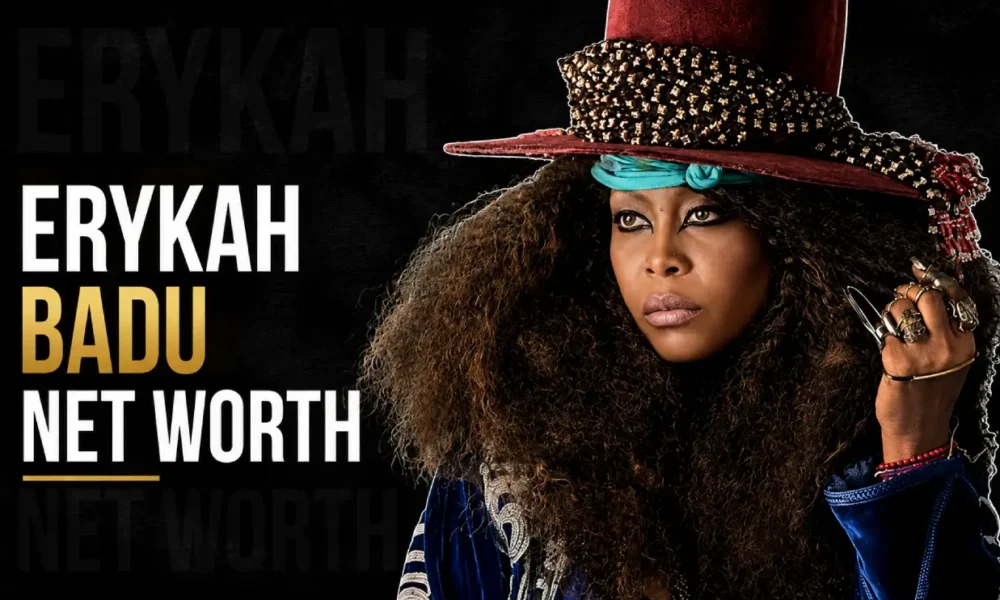
How does an artist who deliberately avoided mainstream commercialism — no radio-friendly pop hooks, no major brand sellouts — still accumulate a multi-million dollar net worth over three decades?
Table Of Content
Erykah Badu did exactly that. Born Erica Abi Wright in Dallas, Texas, on February 26, 1971, she was raised by her mother, actress Kolleen Wright, alongside her younger siblings Eevin and Koryan. She began singing and dancing at the age of four alongside her mother, performing at the Dallas Theater Center and The Black Academy of Arts and Letters under the guidance of her godmother, Gwen Hargrove, and her uncle, TBAAL founder Curtis King.
By 14, she was freestyling for a local radio station alongside artists such as Roy Hargrove. She changed her first name from Erica to Erykah because she believed her original name was a “slave name” — “kah” signifies the inner self — and adopted “Badu” because it is her favorite jazz scat sound.
She debuted in 1997 with Baduizm — an album that went triple platinum without chasing a hit formula. Since then, she has built a financial portfolio that includes music royalties, live performance income, acting credits, a wellness-oriented product business, a record label, a fashion collaboration platform, and a deeply loyal fanbase that has sustained her commercial value longer than most chart-driven artists manage.
In late 2025, she completed The Return of Automatic Slim Tour, celebrating the 25th anniversary of Mama’s Gun, performing at the Hollywood Bowl, Chicago Theatre, Kings Theatre, and 13 other major venues across North America. She also embarked on the Abi & Alan tour with The Alchemist in support of their collaborative album — her first new release since 2010.
As of 2026, Erykah Badu’s net worth is estimated at approximately $10 million, according to widely cited financial tracking sources. That figure reflects something more interesting than raw celebrity wealth — it reflects what deliberate, values-aligned income diversification looks like over a long career.
This article breaks down exactly where that wealth comes from, how her career milestones shaped her financial trajectory, and what her story reveals about building sustainable income without compromising creative identity.
What Is Erykah Badu’s Net Worth in 2026?
Estimated Net Worth: $10 million
This estimate is consistent across multiple financial profiling sources. It places Badu comfortably in the upper tier of neo-soul and alternative R&B artists, though well below mainstream crossover stars.
For context:
| Artist | Estimated Net Worth | Notable Certification |
|---|---|---|
| Erykah Badu | ~$10 million | Baduizm — 3× Platinum |
| D’Angelo | ~$10 million | Voodoo — Platinum |
| Maxwell | ~$12 million | Maxwell’s Urban Hang Suite — 2× Platinum |
| Mary J. Blige | ~$20 million | 9× Platinum career certifications |
| Lauryn Hill | ~$8 million | The Miseducation — 8× Platinum |
The comparison matters financially: artists who maintain niche credibility while diversifying income streams often sustain wealth better than those who peak commercially and then fade. Badu’s net worth has remained stable and reportedly grown in recent years — a sign of healthy underlying asset structure, not just a one-era earnings spike.
How Erykah Badu Built Her Wealth — Career Timeline
Early Life and Discovery (1971–1996)
Badu grew up in Dallas surrounded by women educators — her mother Kolleen (known as Queenie), grandmothers Thelma Gipson and Viola Wilson, and godmother Gwen Hargrove — in a near-100-year-old home where the running soundtrack was Chaka Khan, Pink Floyd, Prince, and Rick James.
After graduating from Booker T. Washington High School for the Performing and Visual Arts — the same school that produced Norah Jones, Roy Hargrove, and Edie Brickell — she studied theater at Grambling State University, a historically black university, before leaving in 1993 to focus on music full time.
In 1995, she moved to Brooklyn and formed the hip-hop duo Erykah Free with her cousin Robert “Free” Bradford. They recorded a 19-song demo called Country Cousins, which attracted the attention of record executive Kedar Massenburg. He set Badu up to record a duet of “Your Precious Love” with D’Angelo and eventually signed her to a record deal with Universal Records.
The pivotal moment came in 1994 when Badu opened a D’Angelo show in Fort Worth. Massenburg was in attendance. That single performance set the entire trajectory of her career in motion.
The Breakthrough — Baduizm and the Neo-Soul Movement (1997–1999)
Baduizm was released on February 11, 1997. It debuted at number two on the Billboard 200 and number one on the U.S. Top R&B/Hip-Hop Albums chart. The album was certified three times platinum by the RIAA.
The album produced four singles:
- “On & On” — peaked at #12 on the Billboard Hot 100; won Best Female R&B Vocal Performance at the Grammys
- “Appletree”
- “Next Lifetime”
- “Otherside of the Game”
Her voice drew immediate comparisons to Billie Holiday, and her visual identity — towering headwraps, ankh jewelry, incense — became inseparable from the music itself. She was a core member of the Soulquarians, the influential collective that included Questlove, D’Angelo, and Common. As Questlove recalled, he was spellbound by Badu from the moment he first saw her perform at the 1996 Soul Train Awards.
Her first live album, Live, was released in November 1997. It featured her signature song “Tyrone” and was certified double platinum by the RIAA.
Sustained Catalog Growth (2000–2010)
| Album | Year | RIAA Certification | Key Single | Chart Peak |
|---|---|---|---|---|
| Baduizm | 1997 | 3× Platinum | “On & On” | #12 Hot 100 |
| Live | 1997 | 2× Platinum | “Tyrone” | — |
| Mama’s Gun | 2000 | Platinum | “Bag Lady” | #6 Hot 100 |
| Worldwide Underground | 2003 | Gold | “Love of My Life (An Ode to Hip-Hop)” | #9 Hot 100 |
| New Amerykah Part One | 2008 | Gold | “Honey” | — |
| New Amerykah Part Two | 2010 | Gold | “Window Seat” | — |
Mama’s Gun marked a commercial high point: “Bag Lady” became her first top-10 single, peaking at #6 on the Billboard Hot 100. It was Grammy-nominated alongside “Didn’t Cha Know?” Worldwide Underground followed with “Love of My Life (An Ode to Hip-Hop),” which reached #9 — her second top-10 hit.
New Amerykah Part Two (2010) featured “Window Seat,” whose music video — shot guerrilla-style in Dallas’s Dealey Plaza — sparked widespread conversation about artistic expression and public performance. For 15 years after that album, Badu did not release a solo studio record. That gap was not a career stall — it was the period during which she built the non-music income channels that now underpin her net worth.
The Mama’s Gun 25th Anniversary Tour (2025)
In July 2025, Badu announced Mama’s Gun ’25: The Return of Automatic Slim — the most significant touring event of her recent career. The 16-date U.S. run kicked off October 3, 2025, at the Hollywood Bowl in Los Angeles.
| Date | City | Venue |
|---|---|---|
| Oct. 3 | Los Angeles, CA | Hollywood Bowl |
| Oct. 4 | Las Vegas, NV | Resorts World Theatre |
| Nov. 16 | Atlantic City, NJ | Hard Rock at Etess Arena |
| Nov. 18 | Boston, MA | MGM Music Hall at Fenway |
| Nov. 20 | Detroit, MI | Fox Theater |
| Nov. 22 | Cincinnati, OH | Andrew J. Brady Music Center |
| Nov. 23–24 | Atlanta, GA | Cobb Energy Performing Arts Centre |
| Nov. 28–29 | Houston, TX | 713 Music Hall |
| Dec. 2–3 | Chicago, IL | Chicago Theatre |
| Dec. 5–6 | Brooklyn, NY | Kings Theatre |
| Dec. 8 | Nashville, TN | The Pinnacle |
| Dec. 10 | Dallas, TX | Pavilion at Toyota Music Factory |
Tickets went on sale via Live Nation pre-sale on July 30, 2025, with a public on-sale following on August 1. The tour included multi-night residencies in Atlanta, Houston, Chicago, and Brooklyn — a format that maximizes per-venue revenue while minimizing logistical costs.
Before the fall tour, Badu also launched the Abi & Alan tour with producer The Alchemist, supporting their collaborative album — her first new release since 2010’s New Amerykah Part Two. That tour ran from August 8 in Seattle through August 24 in Austin.
For context, artists at Badu’s tier typically command $50,000–$250,000 per performance. A 16-date tour of this caliber, plus international dates and a separate collaborative tour, likely generated seven figures in gross touring revenue within a single calendar year.
How Does Erykah Badu Make Her Money?
Badu’s income is not dependent on a single stream. That diversification is both her artistic signature and her financial strategy.
1. Music Royalties and Catalog Earnings
Her recorded catalog spans six studio albums released between 1997 and 2010, with combined RIAA certifications ranging from Gold to 3× Platinum.
Royalties are passive income — they arrive without Badu needing to perform or record. Every stream on Spotify, Apple Music, or YouTube generates a small payment. Multiplied across millions of plays annually, a catalog of this depth generates meaningful ongoing income.
The value of owning master recordings — the original audio files — cannot be overstated. Artists who control their masters collect the full royalty rate rather than a contractual percentage. This is a core wealth distinction in the music industry, and one reason catalog ownership has become one of the most aggressively traded asset classes in entertainment finance. Sony, Universal, and private equity firms have spent billions acquiring artist catalogs precisely because of their reliable royalty income.
Whether Badu owns her masters has not been publicly confirmed in detail. Artists of her generation who signed with Universal Motown often face complex ownership structures — a factor that could significantly affect the long-term value of her catalog.
2. Live Performance and Touring
Live touring is the primary income driver for most working artists, particularly post-2010 as streaming compressed per-unit music revenue.
Badu tours selectively but consistently. The 2025 calendar year alone saw three distinct touring engagements: the Abi & Alan tour with The Alchemist, the Mama’s Gun 25th anniversary fall tour across 16 U.S. dates, and European festival bookings. She is known for:
- Headlining festivals (including Afropunk, Essence Fest, Dreamville Festival, and international bookings)
- Sold-out intimate venue shows with premium ticket pricing
- Multi-night residencies at major venues (Atlanta, Houston, Chicago, Brooklyn — all booked for two nights on the 2025 anniversary tour)
- Hometown finales (the Dallas Pavilion at Toyota Music Factory closed the 2025 tour on December 10)
3. Acting and Screen Work
Badu has a consistent screen presence that supplements her music income:
- Blues Brothers 2000 (1998)
- The Cider House Rules (1999)
- House of D (2004)
- What Men Want (2019)
- Documentaries including Before the Music Dies and The Black Power Mixtape 1967–1975
- Television appearances including Dancing with the Stars and Phenoms
Acting income is project-based and variable, but it keeps her name in cultural circulation during gaps between music releases.
4. Entrepreneurship — Badu World Market and Wellness Brand
This is arguably Badu’s most underappreciated wealth-building channel.
Her Badu World Market e-commerce platform sells:
- Incense and candles (including the signature Badu Pussy Incense line)
- Merch and apparel
- Personal care products
- Her own branded perfume (marketed with unconventional, viral campaigns)
- Collaborative fashion collections (see Badu x SUPA below)
- Vinyl, figurines, and limited-edition memorabilia
The platform runs seasonal sales events — including a Summer Solstice Sale with specific exclusions for high-demand items — suggesting robust direct-to-consumer demand that allows selective discounting without eroding margins on premium products.
Direct-to-consumer merchandise offers significantly higher profit margins than traditional music industry revenue — often 50–70% margins versus the fractional per-stream rates of music. For artists with loyal audiences, merchandise can rival or exceed music income.
She is also a certified doula, having trained and attended births in the Dallas community. Beyond its personal significance, this adds a professional service income layer and deepens the authentic wellness brand identity that drives her product sales.
5. Badu x SUPA — Fashion Collaborations
Badu World Market also serves as a platform for collaborative fashion collections. The Badu x SUPA collection was created by Dallas-based designer Big Tape and includes a letterman jacket, trucker hat, hoodie with matching joggers, t-shirt, and socks — all featuring Kemetic symbolism: pyramids representing Badu’s three children, ankhs representing her earthly accomplishments, and a winged scarab representing rebirth.
As Big Tape described the collaboration: “I just pitched it as a quick idea, something that I thought would be cool for her to wear personally. I just sent a sketch. It was a rough sketch of the letterman, and she actually liked it, and she wanted to proceed.” The project expanded from a single jacket into a full collection, driven by Cold Cris, VP of Operations of Badu World Market.
This model — using Badu World Market as a launchpad for emerging designers while generating revenue from limited-edition collaborative drops — is a scalable extension of her entrepreneurship that most net worth profiles overlook.
6. Control FreaQ Records
In 2016, Badu launched her own record label, Control FreaQ Records. While details of its catalog and revenue are not widely publicized, owning a label gives her leverage over production, distribution, and artist development — creating potential revenue streams from other artists’ work in addition to her own.
7. Brand Partnerships and Cultural Capital
Badu’s brand — spiritual, fashion-forward, unapologetically independent — has attracted selective collaborations with labels including PUMA and various fashion-adjacent brands. In 2024, she received the Fashion Icon award at the CFDA Fashion Awards, further solidifying her status at the intersection of music and fashion. She embraces designers like Rick Owens, Marni, Givenchy, and Thom Browne. As Thom Browne praised her, she stays true to herself through every look.
These deals are typically one-off or limited, in keeping with her reputation for avoiding heavy commercialization, but they contribute to total income while reinforcing the brand equity that drives her other revenue channels.
Erykah Badu’s Cultural Influence — Why Her Brand Never Depreciates
Understanding Badu’s net worth requires understanding why her brand commands loyalty 28 years after her debut.
Her personal style is not decoration — it’s a financial asset. From the moment she appeared on the scene, she projected a powerful, mystical image: towering headwraps, ankh jewelry, incense. Her voice, often compared to Billie Holiday’s, and her role in the neo-soul movement positioned her as an artist whose aesthetic is inseparable from her commercial identity. She was a core member of the Soulquarians, the collective that included Questlove, D’Angelo, and Common — musicians who reshaped the sound of Black music in the late 1990s and early 2000s.
This cultural positioning has financial consequences. Her willingness to make provocative public statements keeps her in public conversation without requiring new music releases. In April 2026, a viral social post falsely attributed a statement to her about investing tithes instead of giving them to churches. Badu responded directly: “I didn’t say that.” The incident — and the widespread discussion it sparked about faith, money, and community wealth — demonstrated exactly how her name generates cultural engagement even outside of music.
That sustained cultural relevance is what allows a selective touring schedule to remain commercially viable. Fans don’t just buy tickets to hear songs — they buy into an experience, a worldview, a community. Attendees at her 2025 anniversary tour described the concert at the Chicago Theatre as “so healing” and “truly timeless.” Audience reactions at the Hollywood Bowl were similarly reverent.
Her team has also taken a proactive stance on protecting her brand from misinformation, issuing formal warnings about AI-generated fraudulent pages impersonating her online. This kind of brand stewardship — defending authenticity in an era of synthetic content — reinforces the trust that underpins her direct-to-consumer sales and fan loyalty.
The financial takeaway: Badu’s brand equity hasn’t depreciated because it was never mass-produced. Selective commercialization — saying no to deals that dilute identity — preserved the scarcity and authenticity that make her cultural capital durable. The CFDA Fashion Icon award in 2024 was not a career comeback; it was formal recognition of something her fans had known for decades.
Erykah Badu’s Estimated Asset Breakdown
Net worth is built on assets, reduced by liabilities. Here’s a probable breakdown:
| Asset Category | Notes |
|---|---|
| Primary Residence | Reported to reside in Dallas, TX — real estate values in Dallas have appreciated significantly over the past decade |
| Music Catalog / Masters | Royalty-generating recordings with long-tail passive income value; ownership structure unclear for some releases |
| Business Equity | Badu World Market e-commerce, product lines, and collaborative fashion ventures |
| Record Label | Control FreaQ Records (launched 2016) |
| Investment Accounts | Likely includes some mix of equities, retirement accounts (self-employed individuals can use SEP-IRA structures) |
| Cash Reserves | Liquid savings for operational and personal use |
Real estate is worth highlighting. Dallas home values have grown substantially over the past 10 years — properties that were worth $400,000 in 2015 are frequently appraised at $700,000–$900,000 today in desirable Dallas neighborhoods. Any real estate held during that period would have contributed meaningfully to net worth growth without active effort.
Financial Lessons From Erykah Badu’s Wealth Strategy
1. Catalog value compounds
Badu’s 1997 recordings still generate royalty income in 2026. The lesson: build or acquire assets that produce income long after the initial effort — whether that’s a music catalog, an investment portfolio, intellectual property, or rental real estate.
2. Brand authenticity is a financial moat
Badu has never mass-commercialized her identity. That restraint preserved the fan loyalty that makes selective touring, premium pricing, and direct-to-consumer sales viable decades into her career. In business terms: protecting your reputation from short-term monetization often produces greater long-term returns.
3. Diversification is wealth architecture, not just risk management
Badu earns from royalties, touring, acting, merchandise, fashion collaborations, a record label, and wellness services. Each stream reinforces the others: her cultural presence drives tour demand, which drives merchandise sales, which reinforces brand identity. The whole is greater than the sum.
4. Own your work
Whether it’s master recordings, a business, or a home — ownership converts effort into equity. Artists who control their masters collect full royalty rates; entrepreneurs who own their businesses build transferable asset value. This principle scales at every income level.
5. A creative gap is not a financial gap
Badu released no solo studio album between 2010 and 2025. During those 15 years, she launched a record label, built an e-commerce business, collaborated on fashion collections, attended births as a doula, and toured selectively. The income didn’t stop — it diversified. For anyone in a creative or entrepreneurial field, a product release gap is an opportunity to build the infrastructure that makes the next release more profitable.
Conclusion
Erykah Badu’s $10 million net worth is the product of nearly three decades of deliberate financial architecture: a triple-platinum debut album, a six-album catalog that continues generating passive income, consistent selective touring — including the major 2025 Mama’s Gun anniversary tour across 16 U.S. venues — entrepreneurial ventures spanning e-commerce, fashion collaborations, and a record label, and brand equity that has never depreciated because it was never compromised.
Her story illustrates a principle that applies far beyond music: wealth built on authenticity and ownership compounds differently than wealth built on volume and compromise. The artists — and professionals, and businesses — that endure financially are the ones that protect what makes them distinctive rather than diluting it for short-term gain.

No Comment! Be the first one.