







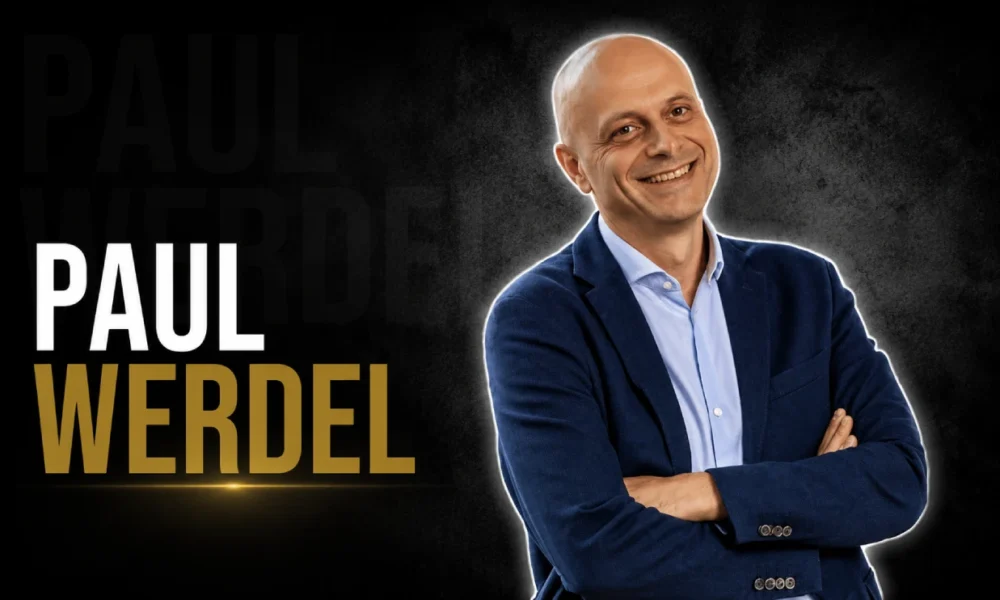
Paul Werdel is an American digital journalist and former Product Director at The New York Times. He is also the husband of Amna Nawaz, co-anchor and co-managing editor of PBS NewsHour. Before stepping back from full-time work in 2018, Werdel built a career across three of the world’s most prominent international news organizations — BBC World News, Al Jazeera English, and The New York Times.
Table Of Content
- Who Is Paul Werdel?
- Quick Bio
- Early Life and Education
- Career in Journalism and Digital Media
- Why Paul Werdel Left The New York Times in 2018
- Amna Nawaz: The Career That Shaped the Decision
- Personal Life and Family
- Stay-at-Home Fathers in Dual-Career Households: The Broader Picture
- Career Timeline
- Paul Werdel’s Net Worth
- What Is Paul Werdel Doing Now?
- Conclusion
What makes Werdel a notable figure is not celebrity — he actively avoids the spotlight. It is the deliberate choice he made at the peak of his career to step aside professionally so his wife’s journalism career could grow without compromise. That decision, made when dual-career households rarely see the man take the caregiving role, has drawn attention from journalists, researchers, and families navigating the same trade-offs.
This article covers what is verifiably known about Paul Werdel — his background, his career contributions, the 2018 transition, and his life today.
Who Is Paul Werdel?
Paul Werdel is a digital media professional who served as Product Director at The New York Times from 2014 to 2018, overseeing the publication’s digital product strategy during a critical period in its transformation from print-first to mobile-first. He previously worked as a journalist and editor at BBC World News, Al Jazeera English, and TPM Media. In 2018, he left the NYT to become the primary caregiver for his two daughters after his wife, Amna Nawaz, accepted a position at PBS NewsHour in Washington, D.C. He has not publicly returned to full-time media work since.
Quick Bio
| Attribute | Details |
|---|---|
| Full Name | Paul Werdel |
| Date of Birth | November 17 (birth year not publicly disclosed) |
| Estimated Age | Approximately 47–49 (as of 2026, based on 1998 university enrollment) |
| Birthplace | Baltimore, Maryland, USA |
| Nationality | American |
| Education | B.A. in Journalism, University of Maryland (1998–2002) |
| Career | Digital Journalist; former Product Director, The New York Times (2014–2018) |
| Spouse | Amna Nawaz (married 2007) |
| Children | Two daughters: Karam and Lina |
| Current Role | Primary caregiver; no publicly announced return to journalism as of 2026 |
| Estimated Net Worth | $1–4 million (estimated; no verified public figure) |
Early Life and Education
Growing Up in Baltimore
Paul Werdel was born and raised in Baltimore, Maryland. Details about his family — parents, siblings, and childhood — remain private by his own preference. He has consistently kept his personal background away from public scrutiny, a pattern that extends into his adult life.
What is clear from his career trajectory is that he developed a strong early interest in both storytelling and the technical side of media production. Baltimore’s proximity to Washington, D.C., and its established media ecosystem likely shaped his awareness of broadcast journalism from a young age.
His birthday, November 17, has been confirmed through biographical sources, though the exact birth year has never been publicly disclosed. Based on his enrollment at the University of Maryland in 1998, he was likely born in the late 1970s.
University of Maryland (1998–2002)
Werdel enrolled at the Philip Merrill College of Journalism at the University of Maryland in 1998, graduating with a Bachelor of Arts in Journalism in 2002. The Philip Merrill College is consistently ranked among the top journalism programs in the United States, with strong ties to the Washington, D.C. media market and a curriculum that emphasizes hands-on production alongside traditional reporting.
During his time there, Werdel worked at UMTV, the university’s student television station, where he gained practical production experience in live studio broadcasting. Biographical sources indicate his work contributed to broadcasts that achieved industry recognition, though the specific awards and years have not been independently confirmed.
This practical focus — learning production by doing it, not just studying it — appears to have been the foundation for the technical fluency he later applied to digital product work at The New York Times.
Career in Journalism and Digital Media
University of Maryland — Lecturer and Production Coordinator (2003–2004)
After graduating in 2002, Werdel returned to the University of Maryland as a Lecturer and Production Coordinator. In this role, he trained students in live studio production and broadcast journalism fundamentals — passing on practical skills rather than theory alone.
This one-year stint before moving into professional media work suggests a genuine investment in journalism education, not merely a transitional stop between student life and a career.
BBC World News (2004–2007)
Werdel joined BBC World News in 2004 as a producer and director for U.S.-targeted programming. His responsibilities included:
- Producing and directing twice-nightly BBC World News broadcasts for American audiences
- Writing and editing scripts and news packages
- Building running orders and scheduling on-air guests
- Adapting internationally sourced reporting for domestic relevance
Working at the BBC during this period — when American audiences were consuming more international news in the post-9/11 environment — gave Werdel early experience in audience segmentation: understanding that the same story requires different framing for different viewers.
Al Jazeera English (2008–2011)
From July 2008 to February 2011, Paul Werdel served as a News Editor at Al Jazeera English. This was a significant period for the network. Al Jazeera English had launched its global broadcast in 2006 and was actively expanding its digital footprint and U.S. presence through the late 2000s, seeking to establish credibility with Western audiences who were often unfamiliar with the brand.
In this role, Werdel developed editorial judgment across stories that required bridging Middle Eastern and Western perspectives — a complex editorial skill that goes beyond writing and into cultural interpretation and news judgment under pressure. His more than three years at Al Jazeera English rounded out an international perspective that few American journalists of his generation had: he had now worked inside the editorial cultures of British public broadcasting, a Qatari-funded international network, and — soon — America’s most prestigious newspaper.
TPM Media / Talking Points Memo (2011–2012)
Before joining The New York Times, Werdel worked as a Senior Associate Editor at TPM Media (Talking Points Memo) for approximately two years. TPM is a digital-native political news outlet founded by Josh Marshall, known for long-form investigative reporting and breaking political news online. The outlet had built a reputation for pioneering blog-driven journalism and crowd-sourced investigations.
This role placed Werdel squarely at the intersection of digital publishing and political journalism — an important bridge between his broadcast background and the product-focused work he would do next. At TPM, he gained experience in how digital-native organizations think about content distribution, audience engagement, and the relationship between editorial judgment and platform design — skills that would prove directly relevant to his later work at the NYT.
The New York Times (2012–2018)
Werdel joined The New York Times in 2012 — a critical period in the publication’s digital history. To understand the significance of his roles there, it helps to understand the internal transformation the NYT was undergoing.
The NYT Innovation Report and Digital Transformation
In 2014, an internal report — known as the Innovation Report — was leaked to the press. It was a remarkable document prepared by a team of seven NYT journalists that laid bare the challenges facing the newsroom. The report found that only about a third of readers ever visited the NYT homepage, and that those who did were spending less time there, with page views and minutes per reader dropping by double-digit percentages. The report argued that the Times needed to fundamentally rethink how it packaged, promoted, and distributed its journalism across digital platforms. At the time, the organization had approximately 14.7 million articles in its archives dating back to 1851, and the report emphasized the opportunity in resurfacing and recontextualizing archival content for new audiences.
The report called for tearing down barriers between the newsroom and the business side, pushing back against “perfectionist impulses” that slowed experimentation, and building new tools that would let journalists — and eventually readers — repackage and curate content. It described the Times as “uniquely well positioned” but “vulnerable to decline” if it did not transform quickly.
By 2016, the publication was generating nearly $500 million in purely digital revenue and had surpassed 1.5 million digital-only subscriptions, up from zero just six years earlier. The Innovation Report’s influence shaped how the organization thought about audience development, content personalization, and the relationship between editorial judgment and product design.
Werdel was inside this transformation throughout its most critical phase.
Werdel’s Roles at the NYT
Over six years, Werdel held three distinct roles that tracked the NYT’s shift from print-first thinking to mobile product development:
- Senior Editor of Platforms — overseeing how editorial content was distributed and formatted across digital channels, including social media, email newsletters, and aggregation platforms
- Senior Product Manager for Mobile — developing the mobile reader experience at a time when smartphone news consumption was becoming the primary mode for most users. The NYT app was becoming a central part of the publication’s subscriber strategy
- Product Director (October 2014 – April 2018) — leading product strategy across digital properties, including cross-functional collaboration with editorial, engineering, and design teams
The NYT’s mobile audience grew substantially during this period, and the publication launched several notable digital products between 2014 and 2018, including an expanded NYT Cooking experience, redesigned article formats, and new briefing products. While Werdel’s specific contributions to individual launches have not been publicly attributed, his role as Product Director placed him in the leadership structure overseeing these initiatives.
Why This Skill Set Mattered
Werdel’s value during this period was the combination of genuine editorial experience — he had been a working journalist and editor at three international outlets — with the product management skills required to build digital tools. That pairing — a journalist who understands product, not simply a technologist handed an editorial brief — was relatively rare and in high demand. The Innovation Report itself had identified the gap between the newsroom’s editorial instincts and the organization’s ability to reach audiences digitally. Werdel was one of the people positioned to bridge that gap.
Why Paul Werdel Left The New York Times in 2018
In April 2018, Paul Werdel stepped away from his position as Product Director at The New York Times. The reason was straightforward: the family was relocating to Washington, D.C., where Amna Nawaz had accepted a position as a correspondent at PBS NewsHour — and someone needed to be the primary caregiver for their two young daughters.
Werdel took on that role.
This was not a reluctant compromise or a gap year. By available accounts, it was a considered choice by two professionals who assessed whose career trajectory was at a more critical inflection point and what their daughters needed. Amna Nawaz had been building toward a major anchoring role for over a decade. Paul Werdel had already done significant work at the top of the industry — BBC, Al Jazeera, and the NYT — and had the flexibility and willingness to step into the caregiving role full-time.
The timing proved significant. In the years that followed, Nawaz became one of the most prominent anchors in American public broadcasting. Whether her trajectory would have been possible on the same timeline without Werdel’s caregiving role is impossible to say with certainty, but the structural reality of their arrangement — one partner carrying domestic responsibilities so the other could pursue a demanding public role — provided the foundation that made it possible.
Amna Nawaz: The Career That Shaped the Decision
To understand Paul Werdel’s 2018 decision, it helps to understand the career it was designed to support.
Amna Nawaz originally planned to become a lawyer. After a fellowship at ABC News, she shifted to journalism, beginning her career at Nightline before joining NBC in 2003. At NBC, she worked on Dateline NBC documentaries and produced investigative pieces, including mortgage crisis investigations that earned a 2008 Emmy nomination for Business and Financial Reporting.
In 2010, she shared a News and Documentary Emmy Award for the NBC News special Inside the Obama White House. She subsequently served as a correspondent and bureau chief at NBC’s Islamabad bureau — one of the most demanding postings in international broadcast journalism.
Nawaz joined ABC News in 2015, anchoring U.S. election and national political coverage during the 2016 and 2017 cycles. She also hosted the ABC podcast series Uncomfortable. She moved to PBS NewsHour in April 2018 — the same month Werdel left the NYT.
Her work at PBS has been distinguished. She contributed as a correspondent on the PBS NewsHour series The Plastic Problem, which received a Peabody Award in 2019. In December 2019, she became the first Asian American to moderate a United States presidential debate when she co-moderated a Democratic Party primary debate. In June 2021, she was named PBS NewsHour’s Chief Correspondent.
In January 2023, Nawaz and Geoff Bennett became co-anchors of PBS NewsHour, succeeding the legendary Judy Woodruff. In March 2025, Nawaz was additionally named co-managing editor alongside Bennett — placing her in both the on-air and editorial leadership of one of the most respected news programs in American broadcasting.
Her awards include a News and Documentary Emmy Award, a Society for Features Journalism award, and a 2022 Peabody Award for her reporting on the mass shooting in Uvalde, Texas. She is also a member of the Inter-American Dialogue, a Washington, D.C.-based think tank focused on Western Hemisphere affairs.
This is the career trajectory that Paul Werdel’s 2018 decision helped sustain.
Personal Life and Family
Paul Werdel and Amna Nawaz met through mutual connections in the journalism world and married in 2007. As of the most recent available information, they remain married. They have been together for nearly two decades — a durable relationship in a profession not known for stable home lives given its irregular hours, constant travel, and live production demands.
They have two daughters: Karam and Lina. The family lives in Washington, D.C. The children’s ages have been referenced in passing in public profiles of Nawaz, though the family has generally kept the girls out of media coverage.
Werdel himself maintains no meaningful public social media presence. He does not have an active public profile on X (formerly Twitter), and his LinkedIn activity has been minimal since departing the NYT. This is consistent with how he has handled his public profile throughout his career — deliberately private in an industry that rewards visibility.
Nawaz has spoken in various interviews about the importance of having a stable family structure as she navigated the demands of live national news anchoring — references that underscore how central Werdel’s caregiving role has been to her professional life.
Stay-at-Home Fathers in Dual-Career Households: The Broader Picture
Paul Werdel’s choice sits within a demographic that is growing but remains a clear minority. According to a 2023 Pew Research Center analysis of U.S. Census Bureau data, 7% of fathers with children under 18 were not employed for pay in 2021 — a figure that has nearly doubled from 4% in 1989. Fathers now represent 18% of all stay-at-home parents in the United States, up from 11% three decades ago.
However, the reasons behind these numbers matter. The Pew data shows that among stay-at-home fathers, only 23% said they were home specifically to care for their family — up significantly from just 4% in 1989, but still well below the 79% of stay-at-home mothers who cited the same reason. About a third of stay-at-home fathers (34%) were not working due to illness or disability, and another 13% each cited retirement or inability to find work.
What distinguishes cases like Werdel’s from the broader statistics is intent and professional context. The majority of stay-at-home fathers in the data are not there by deliberate professional choice. Fathers who voluntarily step back from senior roles to enable a partner’s career advancement represent a much smaller subset — and that subset is less studied precisely because it does not fit the dominant narrative around stay-at-home fatherhood, which has historically been associated with job loss or disability.
A separate 2023 Pew study on breadwinner wives found that in 16% of opposite-sex marriages, the wife is the primary or sole breadwinner, while in 29% of marriages, both spouses earn roughly equal amounts. Even in marriages where wives earn as much as or more than their husbands, women still tend to carry a heavier load of household chores and caregiving. The only marriage type where husbands devote more time to caregiving than their wives is one in which the wife is the sole breadwinner.
In journalism and media specifically — an industry with demanding hours, irregular travel, and live production schedules — the primary caregiver role almost universally falls to women, even in dual-journalist households. Werdel’s arrangement inverts that pattern at a level of professional seniority that makes it visible as a deliberate choice rather than a response to circumstances.
Career Timeline
| Years | Role | Organization |
|---|---|---|
| 1998–2002 | Student, B.A. in Journalism | University of Maryland, Philip Merrill College of Journalism |
| 2003–2004 | Lecturer and Production Coordinator | University of Maryland |
| 2004–2007 | Producer/Director, U.S. Programming | BBC World News |
| 2008–2011 | News Editor | Al Jazeera English |
| 2011–2012 | Senior Associate Editor | TPM Media (Talking Points Memo) |
| 2012–2014 | Senior Editor of Platforms | The New York Times |
| 2014 | Senior Product Manager, Mobile | The New York Times |
| 2014–2018 | Product Director | The New York Times |
| 2018–present | Primary Caregiver | — |
Paul Werdel’s Net Worth
Paul Werdel’s net worth is estimated at $1 million to $4 million as of 2026, accumulated through his journalism and digital product career at BBC World News, Al Jazeera English, TPM Media, and The New York Times.
No verified compensation figures for Werdel have ever been publicly disclosed. For context, Product Director roles at major U.S. media companies during the 2014–2018 period generally commanded salaries in the range of $150,000 to $250,000 annually, according to publicly available salary data from industry sources. However, publishing a specific figure for Werdel without a primary source would be inaccurate, and salary estimates circulating on some biography sites are not traceable to credible sources.
His wife, Amna Nawaz, as a senior anchor and managing editor at PBS NewsHour, earns a professional salary appropriate to her role — though public broadcasting compensation is generally lower than commercial network equivalents.
The net worth figure should be treated as a broad estimate only. It accounts for over a decade of professional work in senior media roles but has not been independently verified.
What Is Paul Werdel Doing Now?
As of mid-2026, Paul Werdel has not announced a return to full-time journalism or digital media work. No new employer, consulting arrangement, or public project has been reported or attributed to him. He continues to maintain a low public profile with minimal social media activity, and he has not given public interviews since leaving the NYT.
All available indicators suggest he remains in a primary caregiving role, though whether that continues full-time as his daughters move through their teenage years is not publicly known.
It is worth noting that a return to digital media or product leadership — should he choose it — would not require starting from scratch. His combination of editorial background and product management experience at the NYT remains highly relevant to the current media landscape. The industry’s ongoing challenges around audience development, content personalization, and mobile-first product design are precisely the areas where his experience sits. His professional network in journalism and digital media is substantial, and the demand for leaders who can bridge editorial judgment and product strategy has, if anything, grown since 2018.
Conclusion
Paul Werdel’s story is, on its surface, a biography — a career path through some of the most important newsrooms in international journalism, followed by a deliberate pivot to family life. But it resonates beyond the biographical because of what that pivot represents.
In a media industry that demands constant visibility, Werdel chose invisibility. In a professional culture that equates career pauses with career endings, he walked away from a senior role at the country’s most prestigious newspaper — not because he had to, but because the family’s circumstances made it the right decision. The career that decision supported — Amna Nawaz’s rise to co-anchor and co-managing editor of PBS NewsHour — is one of the most significant in American public broadcasting in recent years.
Whether Werdel returns to professional media work remains an open question. His skills are relevant, his network is intact, and the industry needs people who understand both editorial and product. But the choice to remain private, to prioritize family over professional visibility, and to let his wife’s career take center stage — that choice has already said something that a return to work would only confirm.


No Comment! Be the first one.