









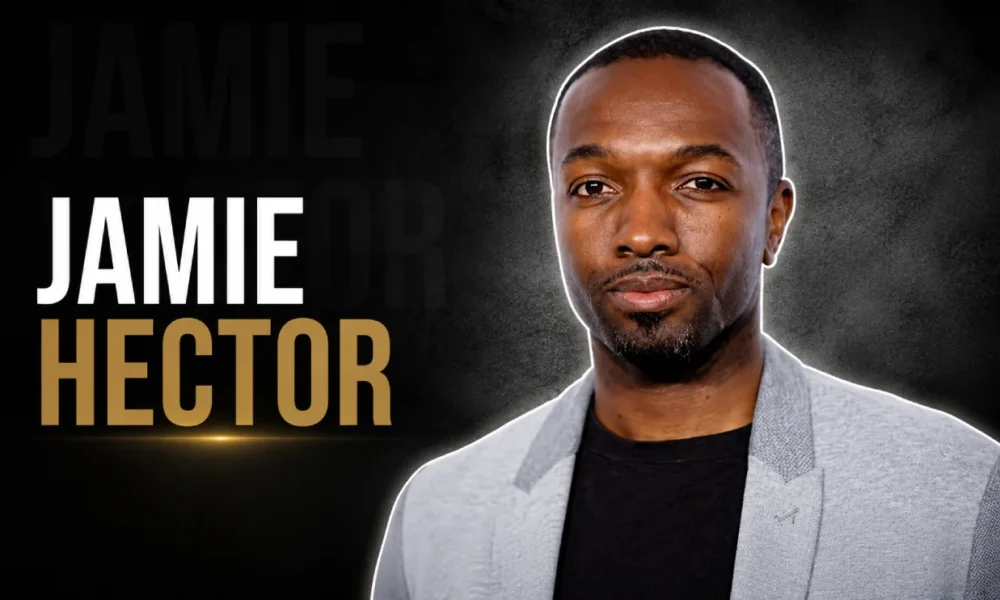
The scar on Jamie Hector’s face has generated more Google searches than almost any detail about his acting career. And yet, after more than two decades in Hollywood, the Brooklyn-born actor has said remarkably little about it — offering only that it has become part of how he builds characters, not something he feels the need to explain.
Table Of Content
- At a Glance
- Early Life: Brooklyn, Haiti, and a Single-Parent Home
- Education and Acting Training
- Career
- Marlo Stanfield vs. Jerry Edgar — Two Sides of Jamie Hector
- The Facial Scar: What We Actually Know
- Beyond Acting: Producing, Writing, and Giving Back
- Jamie Hector and Haitian-American Representation in Hollywood
- Personal Life
- What is Jamie Hector’s Net Worth?
- Conclusion
What fills the space instead is a genuinely unusual career story: a Haitian-American kid from inner-city Brooklyn who trained at one of America’s most demanding acting schools, played one of television’s most chilling drug lords, spent seven seasons as a principled detective, produced award-winning documentary work, wrote bilingual children’s books for Scholastic, and runs a nonprofit that has sent graduates to the Screen Actors Guild.
This is the full picture of Jamie Hector in 2026 — the career, the scar, the family, the philanthropy, and the cultural significance of an actor who has never quite received the mainstream recognition his body of work deserves.
At a Glance
| Full Name | Jamie Hector |
| Date of Birth | October 7, 1975 |
| Age (2026) | 50 years old (turns 51 in October 2026) |
| Birthplace | Flatbush, Brooklyn, New York |
| Profession | Actor, Producer, Author, Philanthropist |
| Nationality | American (Haitian descent) |
| Height | 6 feet 1 inch (1.85 m) |
| Known For | Marlo Stanfield (The Wire), Det. Jerry Edgar (Bosch) |
| Net Worth (2026, estimated) | $3–4 million (third-party estimate) |
| Spouse | Jennifer Amelia (married 2005) |
| Children | Two — daughter Chloé and son Sajes |
Early Life: Brooklyn, Haiti, and a Single-Parent Home
Jamie Hector was born on October 7, 1975, in the Flatbush neighborhood of Brooklyn, New York — home to the largest community of Haitian Americans in the United States. He is the youngest of seven children raised by Haitian immigrant parents. His father left the family shortly after Jamie’s birth, leaving his mother to raise the children alone while working as a nursing assistant.
Haitian Creole was the language of the household. His mother’s stories about life in Haiti — told during the gaps between long work shifts — planted the earliest seeds of Hector’s imagination. Those stories, passed across a kitchen table in Brooklyn, are part of what made him the storyteller he later became.
“I had a lot of fun growing up in Brooklyn, a lot of fun. We played skully, kick the can, and stoop ball. I would ride my bike for miles. Our neighborhood, Flatbush, is home to the largest community of Haitian Americans in the U.S.”
Growing up in a neighborhood where options felt narrow, Hector found his direction in an unexpected place. At age 16, he walked into Tomorrow’s Future, a community theater company, and the course of his life shifted.
Education and Acting Training
Lee Strasberg Theatre and Film Institute
Hector’s formal training came at the Lee Strasberg Theatre and Film Institute in New York — one of the most demanding schools for method acting in the United States, the same institution that shaped alumni including Al Pacino and Marilyn Monroe.
He first built his stage craft at Tomorrow’s Future Theater Company, where live performance gave him a foundation that screen work alone rarely provides. The combination of classical training and a lived understanding of Brooklyn street life gave Hector something that cannot be manufactured: an authentic range.
What Is Method Acting — and How It Shaped Hector’s Craft
Method acting is a performance technique rooted in the work of Lee Strasberg, in which actors draw on personal emotions, memories, and sensory experiences to create psychologically authentic portrayals. Rather than simply performing emotions externally, method actors inhabit their characters from the inside out — living in the emotional reality of the role rather than pretending it.
Hector has credited his Strasberg training throughout his career as the reason he can inhabit characters as different as a calculating drug kingpin and an idealistic detective — and make both feel completely real. The stillness he brings to Marlo Stanfield and the grounded warmth he brings to Jerry Edgar both come from the same method: finding the human truth inside the character, then letting it speak without forcing it.
Career
Five Deep Breaths (2003) — The Short Film That Reached Cannes, Sundance, and Tribeca
Before The Wire, before Bosch, Jamie Hector wrote and produced a short film called Five Deep Breaths (2003), directed by Seith Mann with Hector in the lead role. The film earned official selection at four of the most prestigious film festivals in the world — Cannes, Sundance, Tribeca, and IFP — and went on to accumulate 16 awards.
This is a detail that gets buried in bullet-point lists on most biography pages, but it matters: it established Hector as a creative force behind the camera years before his Emmy recognition as a producer, and it proved that his ambitions extended far beyond acting.
Marlo Stanfield in The Wire (2004–2008)
Jamie Hector joined HBO’s The Wire in 2004, taking on the role of Marlo Stanfield — a cold, methodical drug kingpin ascending through Baltimore’s criminal hierarchy. He appeared in 32 episodes across Seasons 3 through 5.
What made the performance distinctive was restraint. Where other actors might have played the role with visible menace, Hector brought stillness — a quiet that was somehow more threatening than noise. The facial scar, which fans have speculated about endlessly, became an inseparable part of how audiences read Marlo’s history without Hector ever having to explain it.
In 2016, Rolling Stone ranked Marlo Stanfield #2 on its list of the 40 Greatest TV Villains of All Time — a recognition that, a decade later, still appears in critical discussions of the show. The Wire itself continues to be taught in university curricula ranging from criminology to narrative storytelling, and Marlo remains central to those conversations.
Detective Jerry Edgar in Bosch (2014–2021)
From 2014 to 2021, Hector appeared in all seven seasons of Amazon Prime Video’s Bosch (68 episodes), playing Detective Jerry Edgar — the principled, loyal partner to Titus Welliver’s Harry Bosch.
The role was a deliberate counterweight to Marlo. Where Stanfield operated outside every moral code, Edgar worked within one, constantly. Over seven seasons, Hector built one of the more quietly compelling supporting performances in prestige television: a character whose decency never felt naive.
We Own This City (2022) — Full Circle with David Simon
In 2022, Hector returned to HBO and to the world of Baltimore law enforcement in We Own This City, a six-hour limited series developed by The Wire creators David Simon and George Pelecanos. Based on Baltimore Sun reporter Justin Fenton’s book of the same name, the series chronicles the rise and fall of the Baltimore Police Department’s Gun Trace Task Force — a plainclothes unit that went completely rogue, hunting and robbing citizens and drug dealers as decades of mass incarceration and the drug war spiraled out of control.
Hector portrayed Sean M. Suiter, a Baltimore City Homicide detective caught up in the GTTF case who was called to testify before a federal grand jury. The real Sean Suiter was killed in November 2017, the day before he was scheduled to testify — a death that was eventually ruled a suicide by an independent review board, though the circumstances remain controversial.
Casting Hector in this role carried particular resonance. We Own This City brought together an extraordinary number of Wire alumni — including Delaney Williams, Darrell Britt-Gibson, Tray Chaney, Chris Clanton, Jermaine Crawford, Domenick Lombardozzi, and Maria Broom — creating what many critics described as a spiritual companion piece to the original series. Critics debated whether the show was a sequel, a rebuttal, or something else entirely. But having Hector, the face of The Wire‘s most ruthless antagonist, now portraying a real detective destroyed by the same broken system Simon had fictionalized two decades earlier, gave the project a weight that went beyond casting.
Other Notable Roles
Hector’s wider filmography reflects a deliberate range that extends well beyond his two signature roles:
- Paid in Full (2002) — an early film role that preceded his breakout
- Heroes (NBC, 2008) — recurring villain Benjamin “Knox” Washington in Season 3
- Max Payne (2008) — Lincoln DeNeuf, a Haitian crime boss in the video game adaptation
- Night Catches Us (2010) — alongside Kerry Washington and Anthony Mackie
- Halo: Reach — voiced Emile-A239 (Noble 4), a fan-favorite character in the landmark Bungie video game whose popularity introduced Hector to an entirely different audience
- Queen of the South (USA Network, 2017) — Devon Finch in six episodes of Season 2
- Blackout (2007) — opposite Melvin Van Peebles and Jeffrey Wright
Hector also built a foundation in early television with appearances on New York Undercover, Third Watch, Law & Order, and Law & Order: Special Victims Unit during and after his college years.
Marlo Stanfield vs. Jerry Edgar — Two Sides of Jamie Hector
What makes Jamie Hector’s career distinctive is not just that he played two iconic roles — it’s that those roles sit at opposite moral poles, and he made both equally convincing. The comparison reveals the depth of his range:
| Attribute | Marlo Stanfield | Det. Jerry Edgar |
|---|---|---|
| Show | The Wire (HBO) | Bosch (Amazon) |
| Role Type | Lead Antagonist | Lead Supporting / Protagonist |
| Moral Alignment | Amoral — operates by his own code of dominance | Principled — works within the system, often against its flaws |
| Key Trait | Restraint weaponized as menace | Quiet loyalty and professional integrity |
| Seasons / Episodes | Seasons 3–5 (32 episodes) | All 7 seasons (68 episodes) |
| Cultural Recognition | #2 TV Villain of All Time (Rolling Stone, 2016) | Fan-favorite partner dynamic; spinoff discussions reported |
| What Hector Brought | Stillness — making silence more threatening than violence | Warmth — making decency feel earned, not naive |
Very few actors get to play defining roles on both sides of the moral line in prestige television. Hector did it within the same genre — crime drama — which makes the contrast even more striking.
The Facial Scar: What We Actually Know
This is the question that drives more searches about Jamie Hector than any other — and the honest answer, after more than twenty years of public life, is that he has chosen not to answer it.
Hector has a visible scar on the left side of his face. In every interview across his career, he has declined to discuss its origin. He has not denied it, invented a story around it, or reframed it as something else. He simply does not address it.
What he has said, in various interviews, is that the scar has become a tool — that audiences bring assumptions to it, and that those assumptions serve the characters he plays. For Marlo Stanfield, it coded a history of violence. For Jerry Edgar, it added texture to a character whose past the show never fully explored. Hector has used that projection deliberately.
The internet has generated theories ranging from a childhood accident to a fight, none of which come from Hector or anyone close to him. They remain exactly that: theories.
What’s culturally interesting is that the silence itself has become part of his public identity. For an actor who plays characters defined by what they don’t say, it is — whether intentionally or not — entirely consistent.
Beyond Acting: Producing, Writing, and Giving Back
Emmy-Recognized Producing Work
Jamie Hector has served as Executive Producer on The Story of My Number, a sports documentary series that received Emmy recognition. The exact nature and number of Emmy nominations or wins should be verified against Emmy database records, as figures circulating online vary across sources. What is not in dispute is that the producing credit reflects a genuine second career behind the camera — one that began with Five Deep Breaths in 2003.
The Scholastic Haitian Heritage Collection (2024)
In 2024, Hector partnered with Scholastic Publishing to launch “Our Community: Haitian Heritage” — a classroom library designed for students in grades K-3 that explores and celebrates the Haitian experience for children living in Haiti and in the diaspora. The illustrated books are almost entirely written by authors of Haitian descent, and many titles have been transadapted into Haitian Creole — a process that accounts for the fact that Creole is primarily a spoken language, making exact translation from written English impractical.
The collection grew out of the Chloé Wonders book series, which Hector co-wrote with Alaine Roberson, his partner at Moving Mountains. In a 2024 interview with Scholastic, Hector explained the personal roots of the project:
“The books are based on my children. Chloe, 14, is very curious. She loves to ask questions. We decided to create books in which she would not only be able to ask questions, but also to solve problems. My seven-year-old son, Sajes, on the other hand, is a problem solver. We incorporated him into the books, too.”
During Haitian Heritage Month in 2024, Hector donated copies of the collection to schools. The project connects directly to the bilingual household he grew up in: Haitian Creole spoken at home, English at school, and the stories his mother told him functioning as something in between.
Children’s Author — The Chloé Wonders Series
Hector has authored five children’s books under the Chloé Wonders series, co-written with Alaine Roberson and published through Scholastic. Named after his daughter, the books are aimed at early readers and address themes of identity, curiosity, cultural belonging, and problem-solving. The series was transadapted into Haitian Creole as part of the broader Heritage Collection.
Moving Mountains Inc. — Changing Lives Through the Arts Since 2007
In 2007, Jamie Hector co-founded Moving Mountains Inc. with Alaine Roberson, establishing a nonprofit organization based in Brooklyn that provides free year-round classes in drama, dance, vocal performance, and film production to young people from underserved urban communities.
The organization has been running for nearly two decades. Its most publicly notable graduate is Siddiq Saunderson, who went on to play Ghostface Killah in Hulu’s Wu-Tang: An American Saga — a Screen Actors Guild production — after coming through the Moving Mountains program. Saunderson is the most visible example of what the nonprofit produces, but he is not alone. The program has nurtured multiple SAG performers over its history.
For Hector, the work is inseparable from where he came from. He grew up in the same kinds of neighborhoods where Moving Mountains now operates. The arts he found after high school — first at Tomorrow’s Future, then at Strasberg — changed the direction of his life. The nonprofit is, in a direct sense, the same offer extended to the next generation.
Haiti Earthquake Relief
Following the devastating 2010 Haiti earthquake, Hector helped raise money for survivors — an effort rooted in the same connection to his parents’ homeland that drives his cultural and educational work through the Scholastic collection and Moving Mountains.
Jamie Hector and Haitian-American Representation in Hollywood
This is a dimension of Hector’s career that rarely gets the space it deserves.
He is one of a small number of Haitian-American actors working at a recognizable level in American prestige television. The Haitian diaspora in the United States numbers over one million people — culturally distinct, multilingual, and historically underrepresented in mainstream entertainment. There is no industry count of how many Haitian-American actors hold recurring or lead roles in U.S. television, and the absence of that data is itself a measure of the visibility gap.
Hector’s decision to build the Scholastic collection around Haitian Creole, to advocate for stories set in Haitian-American communities, and to speak his heritage language publicly — while this may seem like background detail — represents something meaningful in an industry where Haitian identity has been consistently marginalized or reduced to stereotype.
His career, particularly from 2020 onward, suggests a deliberate effort to change that — through the stories he chooses, the books he writes, and the children he teaches through Moving Mountains.
Personal Life
Jamie Hector married Jennifer Amelia — a wedding planner and event designer who runs Jennifer Amelia Events, LLC — in 2005. They celebrate their anniversary on August 22. The couple has two children: daughter Chloé and son Sajes.
Hector is deliberately private about his family. He rarely brings them into press appearances and has kept both children out of public life, though his daughter’s name appears in the title of his book series.
In July 2009, during a baby shower at their New York home, a shooting took place outside the property when an uninvited individual opened fire. A teenager was killed, and two others were injured. Hector and his family were not harmed. The incident was covered by New York City local press at the time. It is a fact he has rarely spoken about publicly, consistent with his broader approach to protecting his family’s privacy.
What is Jamie Hector’s Net Worth?
Jamie Hector’s net worth is estimated at between $3 million and $4 million as of 2026, according to third-party celebrity financial estimate sites, including Celebrity Net Worth. These are approximations based on publicly known career activity — not verified financial disclosures. They should be read as informed estimates, not confirmed figures.
His income sources span acting fees from television and film, voice acting work in major video game titles, Scholastic book royalties, commercial appearances, and executive producer credits. His continued involvement in new projects and the ongoing cultural relevance of The Wire and Bosch on streaming platforms suggest that his career earnings will grow through the remainder of the decade.
Conclusion
As of August 2026, Jamie Hector has not publicly announced new film or television projects. The Bosch franchise concluded with its final season in April 2026, and earlier reports about a potential Jerry Edgar-focused spinoff set in Little Haiti, Miami have not resulted in an official greenlight from Amazon or any production team. Readers should check entertainment trade publications for the latest updates on Hector’s upcoming work.
Fast Facts
- Joined Tomorrow’s Future theater company at age 16 in Brooklyn
- Trained at the Lee Strasberg Theatre and Film Institute in New York
- Wrote and produced Five Deep Breaths (2003), selected for Cannes, Sundance, Tribeca, and IFP — accumulating 16 awards
- Appeared in 32 episodes of The Wire and all 68 episodes of Bosch
- Rolling Stone ranked Marlo Stanfield #2 among TV’s 40 greatest villains (2016)
- Portrayed real-life detective Sean Suiter in We Own This City (2022)
- Co-founded Moving Mountains Inc. in Brooklyn in 2007 with Alaine Roberson
- Helped raise money for survivors of the 2010 Haiti earthquake
- Launched “Our Community: Haitian Heritage” with Scholastic in 2024
- Has authored five children’s books under the Chloé Wonders series
- Has never publicly explained the origin of the scar on the left side of his face
Jamie Hector’s story is ultimately one of sustained excellence — an actor who built two iconic roles at opposite moral poles, then channeled the same discipline into writing, producing, and changing the lives of young people in the same Brooklyn neighborhoods where his own story began. The most meaningful careers are rarely the loudest ones.
His ongoing commitments to Moving Mountains Inc., the Scholastic book series, and advocacy for Haitian-American representation suggest that his influence will continue to extend well beyond screen roles.



No Comment! Be the first one.