









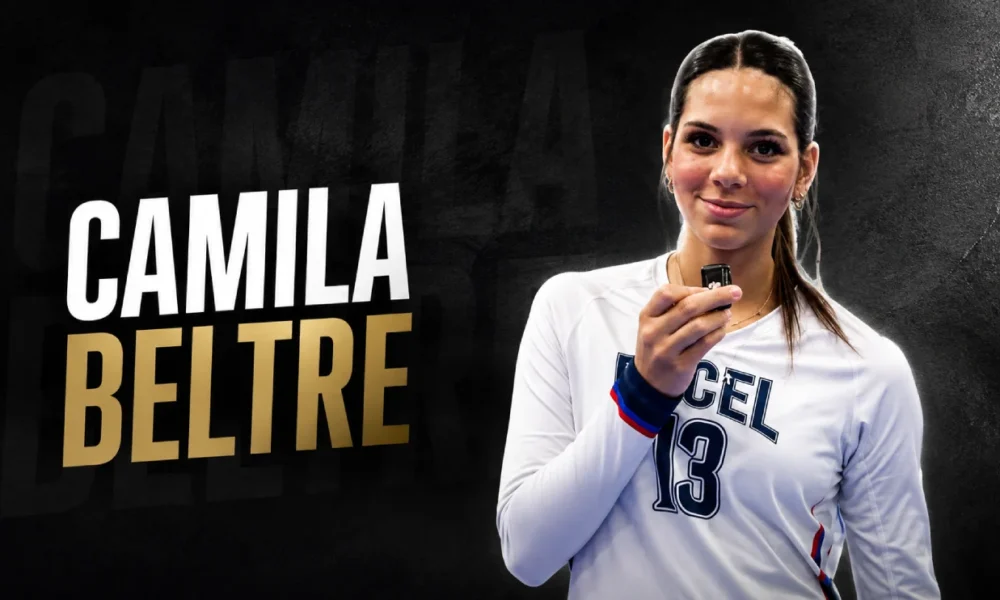
Camila Beltre is a 5’7″ outside hitter, defensive specialist, and libero in the class of 2028 from La Salle College Preparatory in Pasadena, California. She plays club volleyball for Tstreet Volleyball Club and was featured by Prep Dig scout Michelle Bamford as a prospect to watch heading into the USAV National Championships in Dallas. As of August 2026, Beltre is entering her junior year — the stage when NCAA coaches can begin direct communication with recruits.
Table Of Content
Her defensive platform, offensive versatility, and placement within one of the country’s most decorated club programs make her one of the more closely tracked class-of-2028 prospects in Southern California.
This profile covers her playing style, scouting evaluations, club background, recruiting timeline, and what lies ahead for one of Pasadena’s most-watched young volleyball players.
Player Profile at a Glance
| Full Name | Camila Beltre |
| Position | Outside Hitter / Defensive Specialist / Libero |
| Height | 5’7″ |
| Class Year | 2028 (Graduating Spring 2028) |
| High School | La Salle College Preparatory, Pasadena, CA |
| Club | Tstreet Volleyball Club |
| Club Team | Tstreet 14-1 Tara (2024–2025 season) |
| Recruiting Status | Coaches can begin direct written communication as of June 15, 2026 |
| Scouting Coverage | Featured by Prep Dig (Michelle Bamford) ahead of 2025 USAV Nationals |
What the Scouts Are Saying
“Camila Beltre’s defensive platform stands out as a steady foundation for her team. She reads the game well, moves her feet efficiently, and transitions quickly into offense. From the outside she delivers a high, powerful swing and shows the ability to attack angles even when facing a solid block.”
— Michelle Bamford, Prep Dig Scout
That evaluation carries weight. Michelle Bamford is one of the most active recruiting scouts covering youth volleyball nationally, and she specifically identified Beltre as a prospect to know before the USAV National Championships in Dallas — one of the highest-exposure events on the club volleyball calendar. Being named in that group means you’re already on the radar of college programs before your sophomore year even starts.
What stands out in Bamford’s evaluation is the combination of defensive reliability and offensive aggression. Most young outside hitters lean one way or the other. Beltre, according to the scouting report, does both at a level that warranted national attention.
Playing Style Breakdown
Offensive Game — Reading the Block
What separates Beltre from many players her age is her ability to process information quickly during a rally. She adjusts her attack based on the block, cutting the ball sharply left or right with control. When set inside, she delivers a heavy cross-court swing. If the defense leaves a seam, she drives through it with authority.
That kind of volleyball IQ is hard to teach. Most young players at the 14-and-under or freshman level are still learning to recognize blocking patterns. Beltre is already reacting to them in real time. Bamford’s evaluation specifically notes her “high, powerful swing” and “ability to attack angles even when facing a solid block” — language that aligns with what you’d expect from a player a full age group ahead of her peers in terms of court awareness.
Defensive Versatility
Outside hitters who can only hit are limited players. The best ones contribute everywhere on the court, including in the back row. Defensively, Camila plays with urgency and commitment, never hesitating to go after the ball.
This is reflected in her listed positions. She is not just an outside hitter. She is also listed as a defensive specialist and libero, which means her coaches trust her passing and digging skills enough to keep her on the floor in those rotations. Bamford’s evaluation confirms this — calling her defensive platform “a steady foundation” and praising how she “moves her feet efficiently and transitions quickly into offense.” That combination of defensive stability and offensive explosiveness is exactly what college coaches look for in a multi-rotation player.
Court Composure and Leadership
After a key Camino Real League win against Lancaster Paraclete as a freshman, Beltre described the team’s mental approach plainly: “We did face some adversity, but I think that we really took care of it in the end. We knew what we needed to do and I think it worked out for us.”
That kind of language from a freshman is notable. It shows self-awareness and an ability to stay composed when things get difficult — two qualities that coaches at every level specifically look for in recruits.
Her high school head coach, Maurice Torres, backed that up when speaking about the younger players on his varsity roster: “The one thing that they’re not afraid to do is work hard, and I think that’s what’s going to be proved to us later in the season.”
The Tstreet Volleyball Club Advantage
Beltre’s club affiliation matters more than most people outside volleyball circles realize. Club volleyball is the primary space where college coaches do their recruiting evaluation. High school seasons are limited in length and geography. Club seasons run from January through July, include national-level events, and bring elite players from across the country into the same gym.
Tstreet Volleyball Club is not just a good club program. It is one of the most decorated youth volleyball organizations in the United States, with USAV Girls Junior National Championship titles in 2015, 2017, 2019, and 2024.
Key details about the Tstreet environment:
- Coaching pedigree: The coaching staff includes Andy Hein, who served as a D1 assistant at Pepperdine, Cal Baptist, UC Riverside, and UC Irvine, and was a member of the USA Men’s National Team from 2006 to 2013 — winning a gold medal at the FIVB World Championship. Assistant coaches PJ Brown and McLain Mott round out a staff with serious developmental credentials.
- National exposure: Tstreet teams regularly compete at USAV Nationals, AAU Nationals, and major qualifier tournaments across the country, putting players directly in front of college coaches.
- Player development pipeline: The club has a track record of developing athletes who go on to compete at the Division I and Division II college levels. Being part of that system from a young age gives players access to coaching, competition, and exposure that accelerates development quickly.
Beltre was a standout for Tstreet 14-1 Tara, the club’s competitive team at the 14-and-under age group. Playing at that level in Southern California means competing against some of the best young talent in the country, week after week.
Recruiting Outlook for the Class of 2028
NCAA Recruiting Rules — Where the Class of 2028 Stands Now
The recruiting landscape for the class of 2028 has shifted significantly since this article was first published. Beltre and her classmates are no longer in the “pre-contact” phase. Here is where things stand as of August 2026:
| Date / Window | NCAA Milestone | Status for Class of 2028 |
|---|---|---|
| June 15 after sophomore year | Coaches can begin sending written communication (emails, texts, direct messages) | Active as of June 15, 2026 |
| August 1 before junior year | Student-athletes can begin taking unofficial visits to D1 campuses | Opening August 1, 2026 |
| Junior year (full year) | Coaches can make off-campus contact; official visits begin for D1 | Upcoming — 2026–2027 school year |
| Senior November signing period | National Letters of Intent signed | ~November 2027 |
This means the next 12 months are the most critical recruiting window in Beltre’s career to date. Coaches who have been quietly evaluating her at club events and high school matches can now reach out directly. Unofficial visits to campuses are about to become available. The players who use this window strategically — visiting programs, building relationships with coaching staffs, and continuing to perform at high-level events — are the ones who end up with the most options on signing day.
Division-by-Division Physical Standards
Here is what college programs typically look for in an outside hitter, broken down by division level:
| Factor | D1 Standard | D2 Standard | D3 Standard |
|---|---|---|---|
| Height (Outside Hitter) | 6’0″ and above preferred; average is ~6’0″ | 5’10” and above typical | 5’8″ and above typical |
| Approach Jump | 118″ and above average | 105″–115″ range | 95″–110″ range |
| Club Level Experience | Open / National level | Open / Regional level | Regional level |
| Academic Profile | Strong GPA required | Competitive GPA | Flexible; holistic review |
At 5’7″, Beltre will need to demonstrate exceptional athleticism and technical skill to compete for upper-tier D1 roster spots. That said, she is still growing — many players add inches between their freshman and junior years. Even at her current height, there is a clear path forward.
What Coaches Look for in Undersized Outside Hitters
The reality is that not every elite volleyball player is 6’0″ or taller. Programs at every level — including D1 — increasingly value players who compensate for height with other elite traits:
- Defensive platform stability — A player who passes and digs at a high level stays on the court in all six rotations, not just in the front row.
- Volleyball IQ and block-reading ability — Knowing where to place the ball is often more effective than hitting over the block. Bamford’s evaluation specifically highlights this in Beltre’s game.
- Serve-receive consistency — Coaches at the D2, D3, and high-academic D1 level frequently prioritize passing over raw hitting power when building rosters.
- Athleticism across disciplines — Players with beach volleyball or multi-sport backgrounds often show advanced ball control, footwork, and decision-making that indoor-only athletes take longer to develop.
- Competitive pedigree — Tstreet’s national-level schedule means Beltre is already being tested against the best players in her age group. That experience is valued by coaches at every division.
Beltre’s profile — elite club program, defensive versatility, high volleyball IQ, and national-level scouting attention — aligns closely with the profile of undersized outside hitters who successfully compete at the D2, D3, and mid-major D1 levels.
Academic Background
La Salle College Preparatory in Pasadena is known for its rigorous academic environment. The school emphasizes college preparation alongside athletics, and its student-athletes regularly matriculate to competitive universities.
Academic profile is a significant factor in volleyball recruiting, especially at D3 programs and high-academic D1 and D2 schools. Coaches evaluate GPA, course rigor, and standardized test scores alongside athletic performance. Beltre’s enrollment at La Salle positions her well in this regard, though specific academic details are not publicly available at this time.
Conclusion
The next 12 to 18 months will define Camila Beltre’s recruiting trajectory. Here are the key milestones ahead:
- Summer 2026 — Club Nationals and Qualifiers: Beltre’s performance at national-level club events will be the primary data point for coaches building their 2028 boards. These are the tournaments where recruiting decisions begin to crystallize.
- Fall 2026 — Junior High School Season: Her second year of varsity volleyball at La Salle. Junior season is traditionally when recruiting interest peaks, as coaches have a larger sample size of performance data.
- August 2026 Onward — Unofficial Visits and Coach Communication: With NCAA contact rules now active for her class, Beltre can begin visiting campuses and building direct relationships with coaching staffs. How she and her family navigate this process will shape her options significantly.
- Summer 2027 — Final Club Season and Decision Window: The summer before senior year is typically when athletes narrow their lists, take official visits, and begin committing to programs.
Camila Beltre has already done something difficult: she earned varsity playing time as a freshman, secured a spot on one of California’s most competitive club programs, attracted attention from the sport’s top recruiting analysts before her sophomore year, and been positively evaluated for both her defensive foundation and offensive power. That combination of early exposure, high-level training, and genuine talent creates a foundation that most players spend years trying to build.
The question is no longer whether she will have college options. It is how many — and which ones will be the right fit when the time comes to choose.





No Comment! Be the first one.