







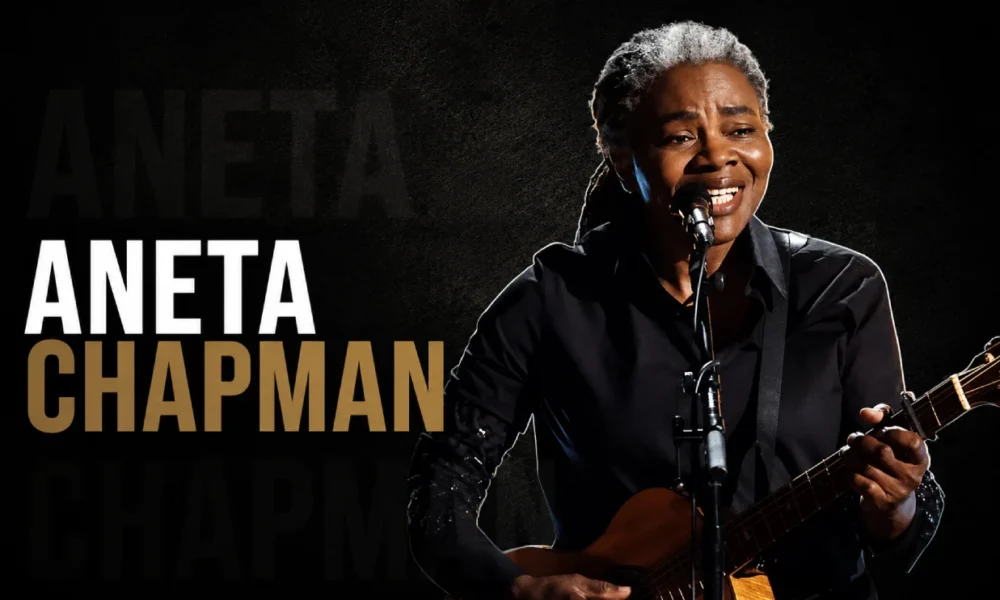
Aneta Chapman is the older sister of Tracy Chapman, the Grammy-winning singer-songwriter behind “Fast Car.” Born in 1962 in Cleveland, Ohio, Aneta is 18 months older than Tracy and played a direct role in shaping her sister’s career from childhood through her rise to global fame. Tracy has publicly credited Aneta at every major milestone: dedicating her 1988 debut album to her, thanking her in three Grammy acceptance speeches, and describing her as “the main reason that anything good in my life has happened.”
Table Of Content
- Who Is Aneta Chapman?
- Early Life in Cleveland, Ohio
- The Sister Behind the Music
- Tracy Chapman’s Rise and Aneta’s Role at Every Step
- The 2023 “Fast Car” Resurgence
- Tracy Chapman’s Songwriters Hall of Fame Induction
- Private Life
- Tracy Chapman’s Public Statements About Aneta
- Why Aneta Chapman’s Story Matters
- Conclusion
In 2023, Tracy Chapman re-entered public consciousness when Luke Combs’ cover of “Fast Car” topped the Country Airplay chart, and Tracy herself performed the song at the 2024 Grammy Awards. That resurgence brought renewed attention to Tracy’s story and to the people who shaped it. Aneta Chapman lives a private life, but her influence on one of music’s most enduring voices is documented in Tracy’s own words, repeated consistently across more than three decades.
Who Is Aneta Chapman?
| Full Name | Aneta Chapman |
| Birth Year | 1962 |
| Birthplace | Cleveland, Ohio |
| Relation to Tracy Chapman | Older sister (18 months apart) |
| Mother | Hazel Chapman |
| Public Profile | No known interviews, no public social media, no recorded public statements |
| Known For | Being the person Tracy Chapman has most consistently credited with shaping her life and career |
Aneta Chapman keeps a low public profile. She does not maintain a visible social media presence and has not given recorded interviews. Most of what the public knows about her comes from Tracy Chapman’s own statements in interviews, award speeches, and published profiles. Her role in Tracy’s life, though, is anything but minor. Tracy has consistently described Aneta as one of the most formative people in her personal and professional development.
Early Life in Cleveland, Ohio
Growing Up in Poverty with a Single Mother
Aneta and Tracy Chapman grew up in a low-income neighborhood in Cleveland, Ohio, in an area known as South Broadway. Their parents were George and Hazel Chapman. Their father was older and more educated than their mother, who did not have her high school diploma when they married. The marriage did not last. Their parents divorced when Tracy was four years old and Aneta was approximately five and a half. Aneta was about six years old when their father left the family entirely, and Tracy was around four.
Hazel Chapman refused child support and raised both daughters on her own while working low-wage jobs. The household faced genuine financial hardship. Hazel relied on welfare and food stamps to keep the family fed. Utilities were sometimes cut off.
Tracy has spoken about this period directly:
“Sometimes there was no electricity, or the gas would be shut off. I remember standing with my mother in the line to get food stamps. We always had food to eat and a place to stay, but it was a fairly bare-bones kind of thing.”
Despite these conditions, neither daughter went hungry, and both had a home. Hazel was deeply committed to her daughters’ well-being. As she later said:
“I feel a certain steadiness because I love my children tremendously. They will always be my first love. They are the only people in the world I will put before myself. I would go through hell for my children.”
Race, Class, and Resilience
Aneta and Tracy grew up acutely aware of race, class, and the structural pressures their mother faced as a single Black woman raising two children. Tracy has said:
“I was very aware of all the struggles my mother was going through, being a single parent and a Black woman trying to raise two kids. I guess there’s some people who can take all that in and not really look at the bigger picture, not see that there are all these forces in society making things more difficult than they ought to be.”
That awareness shaped both sisters. Their mother did everything she could to protect them, but they still endured attacks and harassment in their neighborhood. External pressure only brought the family closer together. It also gave Tracy the raw material that would later define her songwriting, and Aneta was the first person to hear every word of it.
The Sister Behind the Music
How Aneta Shaped Tracy’s Earliest Songs
Hazel Chapman recognized early that her younger daughter had a deep connection to music. She bought Tracy a ukulele at age three. Tracy later learned to play the organ and clarinet, and she would play alongside Aneta, who would sing. It was a household where music was part of daily life. Hazel herself had a beautiful singing voice — she sang in church and at weddings, and she too could play the guitar.
Tracy began playing guitar and writing songs at age eight. She has said she may have first been inspired by watching the television show Hee Haw. From the moment she received her first guitar, Tracy began writing her own songs, expressing her emotions through lyrics and chords. Aneta was there from the very first one.
According to accounts of their childhood, Aneta was the first to hear every song Tracy ever wrote, starting when Tracy was eight years old. She was also the first to offer honest feedback — telling her sister when a song was not good enough, and when to keep going. That dynamic — Tracy creating, Aneta listening and critiquing — became the foundation of Tracy’s development as a songwriter.
“My Best Audience, My Best Critic, My Best Friend”
When Tracy released her debut album in 1988 — a record that reached number one in multiple countries and produced one of the most recognizable folk-rock songs of the 20th century — she dedicated it to her sister Aneta.
At the 1989 Grammy Awards, where Tracy won Best New Artist, Best Female Pop Vocal Performance, and Best Contemporary Folk Album, she thanked her sister specifically during her acceptance speech:
“I’d like to thank my family, my mother who bought my first guitar, and my sister who’s always been my best audience, my best critic, and my best friend.”
These are not vague pleasantries. Tracy chose those three words — audience, critic, friend — with precision. Each describes a different function Aneta served in her life: someone who listened, someone who gave honest feedback, and someone who stayed close through all of it.
Tracy has also said, in a separate context:
“I feel like my sister is the main reason that anything good in my life has happened.”
That statement carries significant weight when you consider the scale of Tracy’s career — over 20 million copies of her debut album sold worldwide, six times platinum certified by the RIAA in the United States alone, four Grammy Awards, and a legacy that spans multiple generations of listeners.
Tracy Chapman’s Rise and Aneta’s Role at Every Step
The 1988 Debut Album
Tracy Chapman’s path to her debut album began with a remarkable act of serendipity. While a student at Tufts University, where she studied anthropology, Tracy busked in Harvard Square and on MBTA Red Line platforms. She recorded demo songs at the Tufts University radio station, WMFO, for copyright purposes. In 1987, a fellow Tufts student named Brian Koppelman heard her perform at a campus coffeehouse and was stunned. He described the moment as “an epiphany,” saying her “presence, her voice, her songs, her sincerity — it all came across.”
Koppelman obtained one of Tracy’s demo recordings from the university radio station and sent it to his father, Charles Koppelman, who ran SBK Publishing. His father flew to Boston to see Tracy perform and eventually signed her. She was later signed to Elektra Records.
The self-titled debut album, Tracy Chapman, was released in 1988. It sold over one million copies in its first week and went on to sell over six million copies in the United States alone. “Fast Car” became a number six hit on the Billboard Hot 100. The album was critically acclaimed, and Tracy began touring and building a global fanbase.
She dedicated the album to Aneta.
Grammy Awards and Public Acknowledgments
At the 1989 Grammy Awards, Tracy won three awards: Best New Artist, Best Female Pop Vocal Performance for “Fast Car,” and Best Contemporary Folk Album. Her acceptance speech included a direct, personal acknowledgment of her sister — not as an afterthought, but as a central figure in the story of her success.
This pattern continued throughout Tracy’s career. Her second album, Crossroads (1989), earned another Grammy nomination. Her fourth album, New Beginning (1995), was certified five times platinum by the RIAA and yielded the hit “Give Me One Reason,” which won the Grammy for Best Rock Song. At each stage, Tracy’s public statements reflected a consistent theme: family first, and Aneta at the center.
Decades of Privacy
After her initial burst of fame, Tracy Chapman gradually withdrew from public life. She released albums less frequently — Let It Rain (2002), Where You Live (2005), and Our Bright Future (2008) — but toured rarely and gave few interviews. She lives a quiet life in San Francisco and has stated that she does not maintain social media accounts.
During these decades of near-silence, the bond with Aneta remained a constant thread. Tracy’s occasional public references to her sister continued to carry the same weight they did in 1989 — personal, specific, and deeply felt.
The 2023 “Fast Car” Resurgence
Luke Combs’ Cover and Its Impact
In March 2023, country artist Luke Combs released a faithful cover of “Fast Car” as part of his album Gettin’ Old. The song became an immediate success, joining the playlists of numerous American and Canadian radio stations — not just country stations. By July 2023, the cover had been certified platinum by the RIAA and reached number one on the Billboard Country Airplay chart. It also climbed to number two on the Hot 100 chart.
Tracy’s original version simultaneously re-entered the Billboard Hot 100 — 35 years after its initial release. The cultural conversation was immediate and intense. Tracy became the first Black person to score a country number one with a solo composition, and the first Black woman to reach the top of the country charts. The significance of a song written by a Black woman from inner-city Cleveland connecting with millions of country music listeners sparked widespread discussion about genre, race, class, and the universal themes in Tracy’s songwriting.
Tracy responded to the moment with a rare public statement to Billboard in July 2023:
“I never expected to find myself on the country charts, but I’m honored to be there. I’m happy for Luke and his success and grateful that new fans have found and embraced ‘Fast Car.'”
Tracy’s Return to the Stage — CMA Awards 2023
On November 8, 2023, “Fast Car” won two CMA Awards: Single of the Year for Luke Combs and Song of the Year for Tracy Chapman. Tracy did not attend the ceremony but had a statement read on her behalf:
“It’s truly an honor for my song to be newly recognized after 35 years of its debut. Thank you to the C.M.A.s and a special thanks to Luke and all of the fans of ‘Fast Car.'”
Luke Combs, accepting his award, said: “First and foremost, I want to thank Tracy Chapman for writing one of the best songs of all time. I never intended [to release it as a single]. I just recorded it because I love this song so much. It’s meant so much to me throughout my entire life. It’s the first favorite song that I ever had, since I was four years old.”
Tracy also appeared on stage at the CMA Awards to perform “Fast Car” with Luke Combs — one of her first public performances in years. The moment was widely described as one of the most significant in CMA history.
The 2024 Grammy Performance
On February 4, 2024, Tracy Chapman and Luke Combs performed “Fast Car” together at the 66th Annual Grammy Awards at Crypto.com Arena in Los Angeles. The performance was widely described as the highlight of the ceremony.
Combs introduced the performance by saying “Fast Car” was his “favorite song before I knew what a favorite song was.” On stage, he stood beside Tracy, visibly moved, as she sang the song she wrote decades earlier. The New York Times wrote that the performance “felt larger than the limitations of genre, expansive enough to hold every single person it had ever touched.”
Cultural commentators noted what the duet represented. A Black woman and a white man sang together about people down on their luck and dreaming of better lives. The song captured something about class and longing that connected across racial and geographic lines — inner-city Cleveland and rural North Carolina alike. USA Today’s Jim Sergent wrote that the performance made him weep, noting that “maybe we saw that our troubles and dreams can connect us, how much more we could accomplish together.”
What This Meant for Tracy’s Family Story
The 2023-2024 resurgence brought a new generation of listeners to Tracy Chapman’s story — and to the people who shaped it. Tracy grew up in poverty, without a father, in a neighborhood that offered few advantages. She built one of the most distinctive careers in modern music. By her own account, Aneta was the most constant force behind that outcome.
As millions of people rediscovered “Fast Car” and learned Tracy’s story for the first time, the question of who stood behind her during those formative years became newly relevant. Aneta Chapman — the sister Tracy has called her “best audience, best critic, and best friend” — is central to that story.
Tracy Chapman’s Songwriters Hall of Fame Induction
In November 2023, Tracy Chapman was nominated for the 2024 class of the Songwriters Hall of Fame. It was her second nomination; she had first been on the 2018 nominees list. The representative songs listed for her catalog were “Fast Car,” “Talkin’ ‘Bout a Revolution,” “Give Me One Reason,” “Baby Can I Hold You,” and “Sing for You.”
Tracy was inducted into the Songwriters Hall of Fame in 2024, making her the first Black woman to be honored as a sole songwriter. In 2025, her debut album was preserved in the National Recording Registry by the Library of Congress — recognition that the record she dedicated to her sister is now considered a defining work of American music.
At each of these milestones, the pattern from 1988 held: the music Tracy created with Aneta’s early encouragement continued to find new audiences and earn new recognition, decades after it was first written.
Private Life
Aneta Chapman is a private person. This is not a matter of speculation — Tracy herself has acknowledged it, and Aneta’s absence from public life over several decades confirms it.
No verified public information exists about Aneta’s profession, residence, or personal relationships. She has not pursued a public career of any kind. She attended public events with Tracy on at least one recorded occasion, but has not sought media attention.
This level of privacy is a deliberate choice. Given that Tracy Chapman has been one of the most recognized musical artists in the world since 1988, Aneta’s ability to remain out of the public eye for nearly four decades speaks to both her personal discipline and the degree to which Tracy has respected her sister’s boundaries. Tracy has never exposed details of Aneta’s private life in interviews, even when discussing her family extensively. The public information reflects what Tracy has chosen to share about their shared experiences, not about Aneta’s individual life.
Tracy Chapman’s Public Statements About Aneta
Tracy Chapman’s statements about Aneta form the clearest picture available of who Aneta Chapman is and what she means to her sister. In Grammy speeches, album dedications, and interviews, Tracy has returned to Aneta repeatedly. The consistency of these references over more than three decades is telling — this is not a one-time acknowledgment but a pattern that reflects a lasting relationship.
The key statements, collected together:
“I’d like to thank my family, my mother who bought my first guitar, and my sister who’s always been my best audience, my best critic, and my best friend.” — Grammy acceptance speech, 1989
“I feel like my sister is the main reason that anything good in my life has happened.” — Interview
“It’s truly an honor for my song to be newly recognized after 35 years of its debut. Thank you to the C.M.A.s and a special thanks to Luke and all of the fans of ‘Fast Car.'” — CMA Awards statement, 2023
Tracy described their mother, Hazel, in similar terms of deep loyalty and love. Hazel herself has spoken about her daughters with unconditional commitment:
“They will always be my first love. They are the only people in the world I will put before myself.”
This family orientation — prioritizing loyalty, staying close despite hardship, and protecting one another — is a thread that runs through Tracy Chapman’s life and music. Aneta sits at the center of that thread.
Why Aneta Chapman’s Story Matters
Aneta Chapman is not a public figure. Her story matters not because she sought visibility, but because her role in Tracy Chapman’s life represents something real about how people build careers and survive difficult circumstances.
Tracy Chapman grew up without financial resources, without a father, and in a neighborhood that offered few advantages. She built one of the most distinctive careers in modern music — a career now recognized by the Songwriters Hall of Fame, the Library of Congress, and a new generation of listeners who discovered “Fast Car” through its 2023 resurgence. By Tracy’s own account, Aneta was the most constant force behind that outcome.
Understanding Aneta means understanding that Tracy Chapman’s success did not emerge from isolation or individual willpower alone. Aneta listened when Tracy played music. She told her what worked and what did not. She stayed present across decades — from childhood in Cleveland through Grammy stages and country music charts. That quiet consistency, without credit, without publicity, shaped the career of an artist that tens of millions of people around the world have connected with.
Conclusion
Aneta Chapman, born in 1962 in Cleveland, Ohio, is Tracy Chapman’s older sister and the person Tracy has most consistently credited with shaping her life and career. Raised in poverty by their mother, Hazel, after their father left the family, the two sisters built a bond that Tracy has described as the most important relationship in her life — one she acknowledged publicly from her 1988 debut album through her 2024 Grammy performance with Luke Combs.
Aneta has chosen a private life, away from public attention, even as Tracy’s music has reached new audiences through the “Fast Car” resurgence of 2023-2024 and her induction into the Songwriters Hall of Fame. Her influence is not documented in interviews or social media posts, but in Tracy’s own words, spoken at nearly every defining moment of a career that has sold over 20 million copies of a single album and now sits in the Library of Congress’s National Recording Registry. Understanding Aneta Chapman is understanding that no artist’s story begins — or endures — alone.

No Comment! Be the first one.