






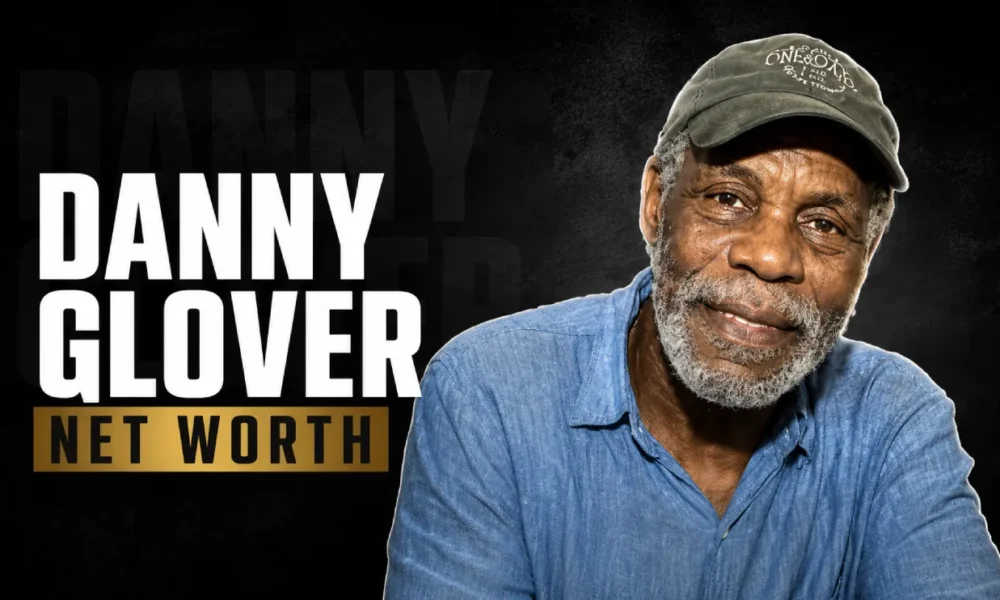
Danny Glover is one of the most recognizable faces in American cinema — an actor, producer, director, and activist whose career spans nearly five decades. His estimated net worth in 2026 stands at $40 million, a figure built not through a single blockbuster windfall but through sustained work across film, television, independent production, and real estate. In July 2026, the 80-year-old Hollywood icon also made headlines for publicly disclosing that he has been living with Alzheimer’s disease, a revelation that has prompted renewed attention to his remarkable life and financial legacy.
Table Of Content
- Danny Glover — Quick Facts
- Who Is Danny Glover?
- Danny Glover’s Net Worth in 2026
- Early Life and Education
- Career Earnings Timeline: Decade by Decade
- How Danny Glover Makes His Money
- Real Estate Portfolio
- Awards, Honors, and Industry Recognition
- Lifestyle and Financial Philosophy
- Danny Glover’s Activism and Philanthropy
- Health: Danny Glover’s Alzheimer’s Diagnosis
- Danny Glover vs. Mel Gibson: A Wealth Comparison
- What Is Danny Glover Doing Now? (2025–2026)
- Challenges and Controversies
- Conclusion
This comprehensive breakdown covers how a former city administrator from San Francisco became one of the entertainment industry’s most financially resilient figures.
Danny Glover — Quick Facts
| Full Name | Daniel Lebern Glover |
| Net Worth (2026) | $40 million (estimated) |
| Born | July 22, 1946 (age 80) |
| Birthplace | San Francisco, California |
| Profession | Actor, Producer, Director, Activist |
| Years Active | 1976–present |
| Notable Franchise | Lethal Weapon (1987–1998) |
| Production Company | Louverture Films (co-founded 2005) |
| Marriages | Asake Bomani (m. 1975; div. 2000), Eliane Cavalleiro (m. 2009; div. 2022) |
| Children | 1 daughter (Mandisa Glover) |
| Major Honor | Jean Hersholt Humanitarian Award, Academy of Motion Picture Arts and Sciences (2022) |
Who Is Danny Glover?
Danny Glover is an American actor and producer best known for playing Sergeant Roger Murtaugh in the Lethal Weapon film series. Beyond his iconic catchphrase — “I’m too old for this” — Glover has built a career defined by dramatic range, political conviction, and financial discipline. He has received five Emmy Award nominations and four Grammy Award nominations, along with the Jean Hersholt Humanitarian Award from the Academy of Motion Picture Arts and Sciences and the NAACP’s President’s Award. He is also a member of the TransAfrica Forum and the Center for Economic and Policy Research, and was awarded the Cuban National Medal of Friendship by the Cuban Council of State for his political work. His production company, Louverture Films, has produced award-winning independent cinema from around the world.
Danny Glover’s Net Worth in 2026
Danny Glover’s net worth is estimated at $40 million as of 2026. That wealth comes from more than four decades of acting income, franchise residuals from the Lethal Weapon series, his independent production company Louverture Films, long-held real estate in San Francisco and Portland, voice acting work, and public speaking engagements tied to his activism. Unlike many Hollywood peers whose wealth is concentrated in one or two paydays, Glover’s financial profile is notably diversified — a model that has proven sustainable well into his late career.
The $40 million figure, widely cited by financial publications and celebrity wealth trackers, is an estimate based on publicly available data including known salaries, property transactions, and production company activity. The actual figure may be higher or lower depending on private investments, contractual residuals, and asset appreciation not captured in public records.
Early Life and Education
Danny Glover was born on July 22, 1946, in San Francisco, California, to Carrie Mae Hunley Glover and James Henry Glover Jr. Both parents were postal workers and active members of the National Association for the Advancement of Colored People (NAACP), working to advance equal rights. His mother was born in Louisville, Georgia, the daughter of a midwife, and graduated from Paine College in Augusta, Georgia — becoming the first person in her family and community to earn a college degree. She went on to serve as regional president of the National Council of Negro Women in San Francisco. His father was a World War II veteran described by Glover as “the most incredibly beautiful man that I ever met.”
Glover grew up in a household shaped by civic values and organized labor — a foundation that would define both his art and his activism. As an adolescent and young adult, he lived with epilepsy, though he has not had a seizure since age 35. He attended George Washington High School in San Francisco and later enrolled at San Francisco State University (SFSU) in the late 1960s. He did not graduate, but SFSU later awarded him the Presidential Medal of San Francisco State University for his service to education.
Before pursuing acting, Glover worked in city administration on community development. He eventually resigned that position to follow his artistic calling, training at the Black Actors’ Workshop of the American Conservatory Theater and with acting coach Jean Shelton at the Shelton Actors Lab in San Francisco. He has spoken about that transition with characteristic directness: “Acting is a platform that can become a conveyer for ideas. Art is a way of understanding, of confronting issues and confronting your own feelings.” He also credits his learning disability — dyslexia — and the awkwardness of being 6’3″ as challenges he had to overcome to find his voice as a performer.
Career Earnings Timeline: Decade by Decade
| Decade | Key Projects | Estimated Cumulative Net Worth |
|---|---|---|
| Late 1970s–1980s | Escape from Alcatraz (1979), Places in the Heart (1984), The Color Purple (1985), Witness (1985), Lethal Weapon 1 & 2 | ~$5–10 million |
| 1990s | Lethal Weapon 3 & 4, Predator 2, Angels in the Outfield, four Emmy-nominated TV films, Grand Canyon | ~$15–22 million |
| 2000s | Louverture Films founded (2005), The Royal Tenenbaums, Saw, Dreamgirls, Shooter, Be Kind Rewind, 2012 | ~$25–30 million |
| 2010s–2020s | Sorry to Bother You, The Last Black Man in San Francisco, Jumanji: The Next Level, Nickel Boys, Jean Hersholt Humanitarian Award, streaming residuals, speaking engagements | ~$35–40 million |
1970s–1980s: Breakout and Lethal Weapon
Glover made his film acting debut in Escape from Alcatraz in 1979, appearing alongside Clint Eastwood. He spent the early 1980s building a reputation as a serious dramatic actor with acclaimed performances in Places in the Heart (1984), The Color Purple (1985), Witness (1985), and Silverado (1985). But the role that transformed his career — and his earning power — came in 1987 when he was cast as Sergeant Roger Murtaugh opposite Mel Gibson’s Martin Riggs in the action film Lethal Weapon. The film grossed over $120 million worldwide and spawned three sequels. By the end of the decade, with Lethal Weapon 2 pulling in nearly $228 million globally, Glover had become one of the most bankable supporting actors in Hollywood.
1990s: Peak Earning Years
The 1990s represented Glover’s commercial peak. Lethal Weapon 3 (1992) earned over $321 million worldwide, and Lethal Weapon 4 (1998) brought in more than $285 million — with Glover earning a reported $7 million for the final installment alone. Outside the franchise, he starred in Predator 2 (1990), To Sleep with Anger (1990), Grand Canyon (1991), Bopha! (1993), and Angels in the Outfield (1994). He also earned four Primetime Emmy Award nominations for his television work — for Mandela (1987), Lonesome Dove (1989), Fallen Angels (1995), and Freedom Song (2000). His recurring roles on series like Hill Street Blues, ER, and later Brothers & Sisters added steady television income on top of his film work.
2000s: Transition to Production
As the Lethal Weapon franchise wound down, Glover shifted his financial model. Rather than chase leading-man salaries, he diversified into character roles in films like The Royal Tenenbaums (2001), Saw (2004), Dreamgirls (2006), and Be Kind Rewind (2008). Most significantly, in 2005 he co-founded Louverture Films with Joslyn Barnes, creating an ownership position in film production that would generate long-term financial and reputational value. He also began investing more deliberately in real estate during this period.
2010s–2020s: Legacy and Reinvention
Glover’s later career has been defined by quality over volume. He appeared in critically praised films like Sorry to Bother You (2018), The Last Black Man in San Francisco (2019), and the box office smash Jumanji: The Next Level (2019), which earned $800.1 million globally. Louverture Films produced Nickel Boys (2024), which received major awards recognition. In 2022, he was honored with the Jean Hersholt Humanitarian Award at the Academy’s Governors Awards — a milestone that elevated his profile across the industry. Streaming residuals from decades of work have also become an increasingly valuable income source, particularly following the improved terms secured by the 2023 SAG-AFTRA contract.
How Danny Glover Makes His Money
Acting Salaries and Residuals
The foundation of Glover’s wealth is a long, steady stream of acting income. Over nearly five decades, he has appeared in more than 70 films and numerous television productions, generating both upfront fees and ongoing residuals. He continues to receive royalties from the Lethal Weapon franchise and other catalog titles — passive income streams that can persist for years or decades after a film’s original release. The improved streaming residual structures negotiated by SAG-AFTRA in 2023 are particularly meaningful for actors with deep back catalogs like Glover’s, as they provide better compensation when legacy titles are viewed on digital platforms.
Lethal Weapon Franchise Earnings
| Film | Year | Glover’s Estimated Salary | Mel Gibson’s Salary | Worldwide Box Office |
|---|---|---|---|---|
| Lethal Weapon | 1987 | ~$1 million (est.) | Not publicly reported | $120.2 million |
| Lethal Weapon 2 | 1989 | ~$3–4 million (est.) | Not publicly reported | $227.9 million |
| Lethal Weapon 3 | 1992 | ~$5–6 million (est.) | $10 million | $321.7 million |
| Lethal Weapon 4 | 1998 | $7 million (confirmed) | $25 million | $285.4 million |
Across all four films, the Lethal Weapon franchise generated approximately $955 million in worldwide box office revenue. Glover’s estimated total earnings from the series — including salary, backend points, and ongoing residuals — are in the range of $15–25 million over the life of the franchise. While his per-film pay was consistently lower than Gibson’s (reflecting their different billing status), the franchise remains the single largest contributor to Glover’s personal wealth.
Louverture Films — Production and Ownership
One of the most significant and underreported pillars of Glover’s financial portfolio is Louverture Films, an independent film and television production company co-founded in 2005 by Glover and Joslyn Barnes. The company is named after Haitian revolutionary Toussaint Louverture and is dedicated to producing socially conscious, internationally focused cinema.
Notable productions include Bamako (2006), Uncle Boonmee Who Can Recall His Past Lives (2010), The House I Live In (2012), Strong Island (2017), Capernaum (2018), and Nickel Boys (2024). Rather than chasing mainstream blockbusters, Louverture has carved out a niche in prestige independent cinema — a model that builds long-term reputational value and generates returns through festival acquisitions, distribution deals, and streaming rights.
“We have challenges in the world and I think art becomes a reframe, a way of looking at that.”
— Danny Glover
In 2022, Louverture expanded into television, animation, gaming, and installation works, bringing on new principal partners to access broader funding resources. This diversification signals a deliberate effort to grow the company’s revenue base beyond theatrical film and position it as a multi-platform content studio. For Glover personally, owning a production company means owning equity — a fundamentally different financial model than simply performing in other people’s projects.
Voice Acting
Glover has lent his distinctive baritone voice to animated films such as The Prince of Egypt (1998) and Antz (1998). Voice work offers competitive fees with less demanding production schedules, and for established actors with recognizable voices, it represents a reliable supplementary income stream.
Speaking Engagements
As one of Hollywood’s most respected voices on social justice, labor rights, and global equity, Glover commands speaking fees at universities, activist events, labor conferences, and film festivals. His public appearances add meaningfully to his annual income and have been enhanced by his Jean Hersholt Humanitarian Award, which has further solidified his standing as a thought leader beyond the entertainment industry.
Real Estate Portfolio
| Property | Location | Details | Value |
|---|---|---|---|
| Buena Vista Avenue home | San Francisco, CA | Purchased 1990; deeded to first wife Asake Bomani in 2003 | Sold 2014 for $10 million |
| 6,000 sq ft residence | Portland, OR | Purchased June 1999 | $1.3 million (purchase price) |
| Current residence | San Francisco, CA | Near Haight-Ashbury, 12 blocks from where he grew up | Not publicly disclosed |
Glover has treated real estate as a deliberate component of his wealth strategy rather than a lifestyle indulgence. His San Francisco property — purchased in 1990 and held for over two decades before being sold for $10 million in 2014 — illustrates how long-term ownership in high-appreciation markets can deliver exceptional returns. His continued residence in San Francisco, within walking distance of his childhood neighborhood in the Haight-Ashbury district, reflects both his financial pragmatism and his personal connection to his roots.
Awards, Honors, and Industry Recognition
Danny Glover’s accolades extend well beyond box office performance:
- Jean Hersholt Humanitarian Award — Academy of Motion Picture Arts and Sciences, Governors Awards (March 25, 2022). Presented by Alfre Woodard, this honorary Oscar recognizes outstanding contributions to humanitarian causes.
- NAACP President’s Award — for distinguished public service.
- Five Emmy Award nominations — including for his portrayal of Nelson Mandela in Mandela (1987), Joshua Deets in Lonesome Dove (1989), Philip Marlowe in Fallen Angels (1995), and Will Walker in Freedom Song (2000).
- Four Grammy Award nominations — for spoken word and audiobook recordings.
- Cuban National Medal of Friendship — awarded by the Cuban Council of State for his political work.
- Presidential Medal of San Francisco State University — for his service to education.
- United Nations Goodwill Ambassador — served with the United Nations Development Programme (1998–2004) and as a UNICEF Ambassador.
In his Jean Hersholt acceptance speech, Glover spoke at length about his parents’ influence and the labor movement that shaped his family: “My mother and father came at a point in time when the labor movement in San Francisco gave them a sense of purpose, raising the family and having this sense that they were connected to a larger story, a larger narrative.” He also acknowledged the role of organized labor throughout his career, referencing his relationship with SEIU 1199 and other labor organizations.
Lifestyle and Financial Philosophy
What distinguishes Glover’s financial story is the relative restraint that defines it. Unlike many Hollywood peers who have chased celebrity excess or made high-risk financial bets, Glover has built wealth incrementally — through work, ownership, and community-rooted values.
His real estate strategy reflects a long-term approach to wealth preservation, prioritizing properties in high-appreciation markets held over extended periods. Louverture Films follows a similar philosophy: quality and purpose over short-term commercial maximization. Even his choice of acting roles in later years — favoring independent films with artistic integrity over studio paychecks — reflects a consistent pattern of prioritizing long-term reputation over immediate earnings.
Glover has also dedicated significant time and resources to causes beyond the entertainment industry. His work as a United Nations Development Programme Goodwill Ambassador (1998–2004) focused on poverty, disease, and economic development in Africa, Latin America, and the Caribbean. These commitments don’t directly generate income, but they have enhanced his public profile, expanded his global network, and created professional opportunities — including speaking engagements, board positions, and access to international film communities — that continue to translate into financial value.
Danny Glover’s Activism and Philanthropy
Glover’s activism is not separate from his career — it is woven into it. The son of NAACP members who grew up during the civil rights era, he has been politically engaged since his student days at San Francisco State University, where the 1968 Black Student Union strike led to the creation of the Third World Coalition. Throughout his career, he has been a vocal advocate for labor rights, racial justice, and global equity.
He is a member of the TransAfrica Forum and the Center for Economic and Policy Research. He has supported workers’ rights campaigns, participated in picket lines, and used his platform to draw attention to economic inequality around the world. Louverture Films itself is an extension of this philosophy — a production company built explicitly to amplify stories from underrepresented communities and regions.
While specific charitable contribution amounts are not publicly disclosed, Glover’s decades of advocacy, UN ambassadorship, and consistent support for labor and civil rights organizations represent a substantial commitment of both time and resources that has shaped his public identity and, by extension, his professional opportunities.
Health: Danny Glover’s Alzheimer’s Diagnosis
In a July 2026 interview on NBC’s Today show, Danny Glover publicly disclosed that he has been living with Alzheimer’s disease for several years. He revealed that he received the diagnosis shortly after receiving the Jean Hersholt Humanitarian Award in 2022. “I can live with it in a sense,” Glover said. “I’m sure as it advances, things are going to be different and changing.”
His daughter, Mandisa Glover, spoke about why her father chose to go public: “I think it’s really important for him to have control of his own narrative, of his own life story. And the time is now.”
The disclosure has prompted renewed attention to Glover’s legacy and raised natural questions about his financial future. Alzheimer’s disease typically requires increasing levels of care over time, and long-term care costs can be substantial. However, Glover’s diversified income streams — residuals, real estate assets, and Louverture Films — provide a financial foundation that, by most assessments, is well-positioned to support ongoing needs. His decision to share his diagnosis publicly has also been widely praised as an act of courage that helps reduce stigma around the disease.
Danny Glover vs. Mel Gibson: A Wealth Comparison
| Metric | Danny Glover | Mel Gibson |
|---|---|---|
| Net Worth | $40 million | $425 million |
| Age | 80 (born July 22, 1946) | 70 (born January 3, 1956) |
| Highest Confirmed Film Salary | $7 million (Lethal Weapon 4) | $25 million (Lethal Weapon 4) |
| Production Company | Louverture Films (socially conscious indie cinema) | Icon Productions (blockbusters and passion projects) |
| Primary Career Path | Character actor and independent producer | Leading man, director, and self-financing producer |
| Academy Awards | Jean Hersholt Humanitarian Award (2022) | Best Director + Best Picture for Braveheart (1996) |
| Key Financial Move | Diversified income streams and long-term real estate | Self-financed The Passion of the Christ ($45M investment → $400–475M personal profit) |
The $385 million gap between their net worths is striking, but it tells an important story about how wealth is built in Hollywood. Gibson’s fortune is overwhelmingly defined by a single extraordinary gamble: investing $45 million of his own money into The Passion of the Christ (2004), which ultimately generated a personal return of $400–475 million when box office, merchandising, and DVD revenues were totaled. Without that one investment, Gibson’s net worth would be substantially lower and far closer to Glover’s.
Glover’s wealth, by contrast, was built through the model most working actors actually follow: consistent earnings across many projects over many years, supplemented by smart investments and ownership positions. For Lethal Weapon 4, Gibson reportedly earned $25 million to Glover’s $7 million — a ratio that reflects their different billing status at the time. But Glover’s diversified approach — real estate, production company ownership, residuals, and speaking income — has proven remarkably durable. His $40 million represents the kind of steady, sustainable financial growth that, while less dramatic than Gibson’s windfall, is arguably more instructive for anyone thinking about long-term financial planning.
What Is Danny Glover Doing Now? (2025–2026)
As of mid-2026, Danny Glover continues to live in San Francisco, near the Haight-Ashbury neighborhood where he grew up. Despite his Alzheimer’s diagnosis, he has remained publicly active — the Today interview itself was a deliberate effort to stay engaged with the public on his own terms.
Louverture Films remains active, with the success of Nickel Boys (2024) bringing renewed attention to the company’s mission and output. While Glover’s level of day-to-day involvement in the company may evolve as his condition progresses, the infrastructure he has built — with co-founder Joslyn Barnes and newer principal partners — is designed to continue beyond any single individual’s participation.
His Jean Hersholt Humanitarian Award and public Alzheimer’s disclosure have both reinforced his status as a cultural figure whose significance extends far beyond his filmography. Industry observers expect that his legacy will increasingly be defined not only by the roles he played on screen but by the institutions he built and the causes he championed off screen.
Challenges and Controversies
Glover’s career has not been without complications. His decision to seek Venezuelan government funding — the National Assembly of Venezuela approved $18 million for a Toussaint Louverture biographical film in 2007 — drew significant criticism and scrutiny, particularly given his political associations. The film was never completed, and the episode raised questions about the intersection of his activism and his professional ambitions.
His outspoken political views have occasionally made him a polarizing figure in an industry that often rewards neutrality. However, those same views have also built him a devoted global audience, opened doors in international cinema that might otherwise have remained closed, and aligned him with communities and institutions — from labor unions to the United Nations — that have provided both purpose and professional opportunity throughout his career.
His two divorces — from Asake Bomani in 2000 and from Eliane Cavalleiro in 2022 — are also relevant to his financial picture, as divorce proceedings can involve significant asset division, though specific details of any settlements have not been made public.
Conclusion
Danny Glover’s $40 million net worth is the product of nearly five decades of sustained effort across multiple disciplines — acting, production, real estate, and public advocacy. Unlike celebrities who accumulate wealth through a single explosive moment, Glover built his fortune through consistent work, shrewd property investments, and the long-term value of owning a production company rather than simply performing in other people’s films.
His financial story is a case study in what longevity looks like in Hollywood: not maximum visibility or maximum risk, but steady ownership, purposeful reinvestment, and a reputation that keeps generating opportunities long after the blockbuster years have passed. The Lethal Weapon residuals continue to arrive. Louverture Films continues to produce acclaimed work. And his public standing — now further deepened by the courage of his Alzheimer’s disclosure — continues to create value in ways that don’t always show up on a balance sheet.
Whether he’s collecting residuals from a 1987 action classic, producing an award-winning documentary, or speaking at a global justice conference, Danny Glover remains one of the most financially resilient and culturally significant figures of his generation in the entertainment world. At 80, his story is still being written — and his decision to share that story on his own terms may be his most powerful act yet.

No Comment! Be the first one.