




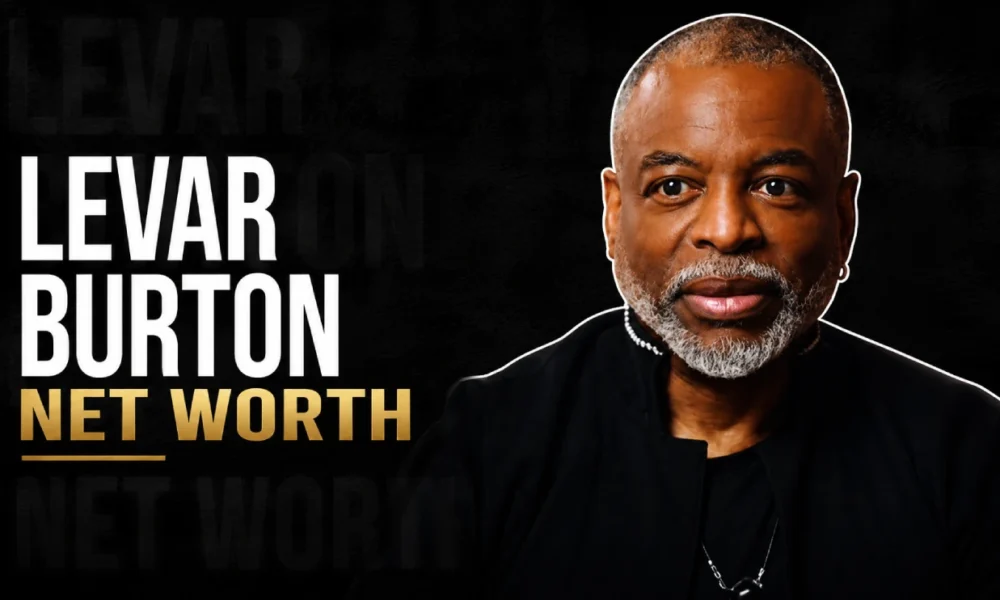
In 1977, a 19-year-old USC theater student sat in front of a camera and helped reshape how America talked about slavery. That student was LeVar Burton. The show was Roots. What followed was a career that touched three generations — Star Trek: The Next Generation, 23 years of Reading Rainbow, a production company, a podcast downloaded over 25 million times, and a trivia game show entering its second season. Along the way, Burton picked up 13 Emmy Awards, a Peabody, a Grammy, a star on the Hollywood Walk of Fame, and a National Humanities Medal.
Table Of Content
Yet his net worth sits at an estimated $6 million. That number isn’t a punchline. It’s a case study in how wealth accumulates when you build ownership, diversify income, and stay relevant across five decades — without ever chasing a single blockbuster payday.
Here’s how Burton built that $6 million, what his financial architecture reveals, and what anyone can learn from a career designed around consistency rather than windfall.
At a Glance (2026)
| Category | Detail |
|---|---|
| Estimated Net Worth | $6 million |
| Primary Income Sources | Acting, hosting, production, IP royalties, speaking engagements |
| Active Projects (2026) | Trivial Pursuit Season 2 (The CW) |
| Production Company | LeVar Burton Entertainment (LBE) |
| Speaking Fee | $100,000 – $125,000 per engagement |
| Real Estate | Los Angeles (Sherman Oaks) |
| Career Span | 1976 – present (49+ years) |
While $6 million is modest by Hollywood blockbuster standards, it reflects something more financially instructive: wealth built through consistency, ownership equity, and purpose — not a single windfall.
Who Is LeVar Burton? Three Roles That Defined American Television
Kunta Kinte in Roots (1977): A 19-Year-Old Changes the Conversation on Slavery
Roots was not just Burton’s breakout role — it was his first professional audition. Cast as a sophomore theater major, he portrayed Kunta Kinte, an African youth kidnapped into slavery, in an ABC miniseries that aired over eight consecutive nights to more than 100 million viewers. To put that in perspective: roughly half the American population watched the same show, at the same time, for over a week.
Restaurants reported empty tables. Theaters saw attendance plummet. Parents across the country named their newborns Kunta and Kizzy. The series didn’t just launch Burton’s career — it forced a national conversation about chattel slavery that had been largely absent from mainstream media.
Burton has reflected on the experience with characteristic clarity: “With the Roots experience, I was able to observe this nation become changed, especially in terms of how we talked about chattel slavery.”
Reading Rainbow (1983–2006): A Quiet Revolution in Children’s Literacy
Six years after Roots, educators in Nebraska and Buffalo were developing an unusual idea: a children’s show that didn’t teach reading skills, but cultivated a love of reading. The concept came from Dr. Twila Liggett, a former teacher who wanted television that made children genuinely excited about books.
When producers spotted Burton at a children’s television conference, the match was immediate. Burton had his own reasons for signing on — his mother had been an English teacher before becoming a social worker, and he’d already hosted Rebop, a multicultural PBS show for young people.
What made Reading Rainbow revolutionary wasn’t just the format. Burton spoke directly to the camera as if talking to a single child, not millions. At the end of each episode, children — not adults — recommended other books. “But you don’t have to take my word for it,” Burton would say, and a kid’s voice would take over. It was a small production choice with a profound psychological effect: it told children their opinions about books mattered.
Over 21 seasons and 155 episodes, the show won 26 Emmy Awards, including 10 for Outstanding Children’s Series, and a Peabody Award for its Vietnam Veterans Memorial episode.
Geordi La Forge in Star Trek: The Next Generation (1987–1994)
When Burton landed the role of the blind chief engineer on Star Trek: TNG, the show’s production team structured his schedule so he could continue filming Reading Rainbow on weekends. For seven years, he worked a dual schedule — Star Trek during the week, Reading Rainbow on weekends. It was, by all accounts, grueling. But it meant Burton never abandoned the children’s show that had become his signature cause.
The role of Geordi La Forge also carried cultural weight. Burton played a Black man in the 24th century whose blindness was a non-issue — corrected by technology, never defining his capability. “I look at Kunta. I look at Geordi,” Burton has said. “I’ve been able to express humanity as enslaved in the past and as free in the future, and do it as a completely liberated Black man.”
How LeVar Burton Earns His Money
Acting Salaries and the Power of Residual Income
Burton’s acting career generates two types of income: upfront salaries when productions air, and residuals — recurring payments every time a show re-airs or streams. With Star Trek: The Next Generation streaming on Paramount+ and Roots available on multiple platforms, residual checks continue arriving decades after filming wrapped.
Burton himself has spoken candidly about how central residuals have been to his financial life. During the 2023 SAG-AFTRA strike, he shared publicly: “My Star Trek residuals were all I had, and they kept me afloat for two decades while I rebuilt my life.” He also revealed he was the lowest-paid cast member on TNG in 1988 — a reminder that even within a hit show, income varies dramatically by contract structure and negotiating position.
This is one of the most underappreciated passive income mechanisms in entertainment. Residuals don’t require new work. They pay because content continues to be consumed — and in the streaming era, that consumption is nearly infinite.
Speaking Engagements: A Six-Figure Income Stream
Most celebrity net worth profiles overlook this entirely. Burton commands $100,000 to $125,000 per speaking engagement, primarily in the education and authors/storytellers categories. For someone with his name recognition and multi-generational appeal, even a handful of corporate keynotes, university commencement addresses, and conference appearances per year represents a significant income stream — potentially $300,000 to $500,000+ annually — that requires no production investment, no crew, and no distribution deal.
Reading Rainbow: 23 Seasons of Production Equity
The crucial financial distinction: Burton wasn’t just the host of Reading Rainbow — he was the executive producer. Producers earn backend compensation, ownership stakes, and licensing fees that hosts do not. When he and business partner Mark Wolfe later launched children’s media company RRKIDZ, they monetized that intellectual property further.
In 2014, Burton launched a Kickstarter campaign to revive Reading Rainbow digitally. The campaign raised over $5 million — making it one of the most successful in Kickstarter history — and directed the funds toward bringing the show’s educational content to classrooms nationwide.
Trivial Pursuit (2024–Present): His Most Active Income Stream
This is the section most competitors miss entirely. Since October 2024, Burton has hosted the Trivial Pursuit game show on The CW, developed in partnership between LeVar Burton Entertainment and Entertainment One (eOne), Hasbro’s content studio. The show is taped in London.
The CW renewed the show for a second season. Burton serves as both host and executive producer — a dual role that means he earns compensation on both the talent side and the business side of the production.
Tara Long, President of Global Unscripted Television at eOne, described the partnership this way: “LeVar Burton has been an iconic member of American pop culture for decades from Roots to Reading Rainbow to Star Trek and beyond. His love for intellectual curiosity paired with his ability to connect with audiences worldwide make him the perfect partner to bring Hasbro’s beloved trivia game to households in a new and exciting way.”
Game show hosts earn base salaries ranging from $50,000 to $500,000+ per season, depending on network and ratings. As both host and executive producer, Burton earns dual compensation — making this his most current and actively growing income source.
LeVar Burton Entertainment: The Business of Storytelling
Burton founded LeVar Burton Entertainment (LBE) with a mission to “create content that builds community, fosters empathy, and champions diversity.” The company is led by CEO Sangita Patel and Director of Development Isabelle Redman Dolce, and is developing a range of film and television projects with award-winning writers and producers.
LBE generates revenue through development deals, licensing, distribution agreements, and co-production partnerships. Owning a production entity means Burton earns on the business side of content — not just as talent in front of the camera. The company is represented by WME.
Books, Podcasts, MasterClass, and Digital Revenue
Burton has authored Aftermath, The Rhino Who Swallowed a Storm, and A Kids Book About Imagination. He partnered with MasterClass to teach the power of storytelling and launched the LeVar Burton Book Club through the Fable app.
His podcast, LeVar Burton Reads, accumulated over 25 million downloads and more than 175 episodes. His newer podcast, Sound Detectives, premiered at number one on the Kids & Family charts. In 2023, he executive-produced his first documentary, The Right to Read, which frames America’s literacy crisis as a civil rights issue and is now available on Apple TV, Prime Video, Google Play, Kanopy, Vudu, and YouTube.
Awards, Honors, and National Recognition
Burton’s career honors span acting, education, ethics, and public service — a combination nearly unmatched in American entertainment:
| Award / Honor | Details |
|---|---|
| Emmy Awards | 13 total, spanning Reading Rainbow and other projects |
| NAACP Image Awards | 3 awards |
| Peabody Award | Reading Rainbow: “The Wall” episode (Vietnam Veterans Memorial) |
| Grammy Award | Best Spoken Word Album |
| Fred Rogers Award | Media and children’s advocacy |
| Inamori Prize for Ethics | Ethics in Entertainment |
| Hollywood Walk of Fame | Star dedicated for television |
| National Humanities Medal | Awarded by President Biden, 2023 |
| Children’s & Family Emmy | Lifetime Achievement Award |
| LeVar Burton Park | Dedicated by the City of Sacramento in his honor |
| National Commission on Libraries | Appointed Commissioner by President Bill Clinton |
In October 2024, Burton stood in the Oval Office as President Biden placed the National Humanities Medal around his neck — recognition not for a single performance, but for a lifetime of using storytelling to educate, inspire, and advocate.
LeVar Burton’s Assets: What He Actually Owns
Assets are the building blocks of net worth. Here’s what is publicly known about Burton’s holdings:
- Real Estate: In 1996, Burton and his wife Stephanie purchased a home in Sherman Oaks, California for $1.475 million. Los Angeles real estate has appreciated significantly since — properties in Sherman Oaks that sold for under $2 million in 2009 routinely trade at $3 million to $5 million+ today, though current property holdings cannot be confirmed with precision.
- Intellectual Property: His connection to Reading Rainbow, Star Trek, and his podcast library represents ongoing royalty-generating assets — income that flows without requiring active work. As Burton himself acknowledged during the 2023 SAG-AFTRA strike, those Star Trek residuals carried him financially for two decades.
- Production Company (LBE): As the founder of LeVar Burton Entertainment, his equity in that company is itself an asset, valued based on its active projects, deal pipeline, and partnership with eOne/Hasbro.
- Brand & Speaking Value: With a speaking fee of $100,000 to $125,000 per engagement, Burton’s personal brand functions as a liquid asset — convertible to income on a per-event basis with virtually no overhead.
What Burton’s Financial Architecture Teaches Us
Lesson 1 — Own the content, don’t just perform it.
Burton’s biggest wealth multipliers came when he moved from talent to producer. Executive producing Reading Rainbow meant backend compensation and IP ownership that hosting alone would never have provided. Taking the same EP role on Trivial Pursuit four decades later shows the pattern is deliberate, not accidental. In any career, this means moving from employee to business owner, from renter to property owner, from saver to investor.
Lesson 2 — Residuals are the original passive income.
Burton has been explicit: Star Trek residuals kept him afloat for 20 years. For non-actors, the principle translates to dividend-paying stocks, rental income, royalties from books or courses, or any asset that pays you repeatedly for work done once. The goal is to stop trading time for money — or at least to make sure not all of your income requires your presence.
Lesson 3 — Longevity compounds in ways that luck cannot.
A career generating $150,000 per year for 40 years totals $6 million in gross income before any investment growth. Invest even 15% of that at a 7% average annual return, and the portfolio alone exceeds $3 million at retirement. Burton’s $6 million net worth on 49 years of work isn’t low — it’s the math of consistency applied to a career that prioritized mission over maximum extraction.
Lesson 4 — Multiple income streams protect against industry volatility.
Acting + production + hosting + books + podcasting + speaking + book club + documentary = financial resilience. When one stream slows — or when the industry shuts down for a strike — others carry the load. Burton’s career is a masterclass in never relying on a single check.
Conclusion
LeVar Burton’s $6 million net worth is less a Hollywood footnote than an architecture manual. Every major wealth decision — becoming executive producer on Reading Rainbow, acquiring the brand, founding LBE, taking EP credit on Trivial Pursuit — followed the same principle: own the work, don’t just perform it.
His career spans a 19-year-old’s first audition that 100 million Americans watched, a children’s show that redefined how a generation relates to books, a Star Trek role that imagined a liberated Black future, a National Humanities Medal from the President of the United States, and — at age 68 — a game show that’s still taping in London.
The money follows the mission. It always has.


No Comment! Be the first one.