









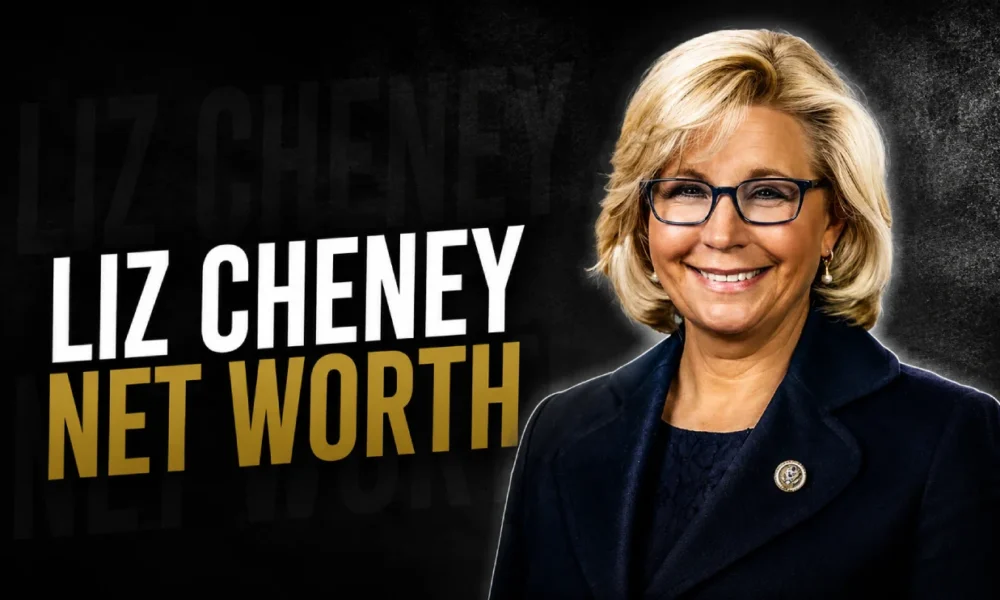
Liz Cheney is one of the most talked-about political figures in recent American history — not just for her policy positions, but for the principled stand that ultimately cost her a congressional seat and reshaped her financial life entirely. Her endorsement of Kamala Harris in the 2024 presidential race — alongside her father, former Vice President Dick Cheney — cemented a dramatic political evolution that few could have predicted a decade ago.
Table Of Content
- What Is Liz Cheney’s Net Worth Today?
- Background and Early Career
- How Liz Cheney Makes Money: Income Sources Breakdown
- Real Estate and Major Assets
- The Household Factor: Philip Perry’s Career and Income
- The 2024 Election: Cheney’s Bipartisan Endorsement
- How Her Political Stance Reshaped Her Financial Future
- What Is Liz Cheney Doing Now?
- Financial Timeline
- How Does Liz Cheney’s Net Worth Compare?
- Conclusion
But beyond the headlines and the political theater, there’s a financial story that’s equally compelling. As of 2025, Liz Cheney’s estimated net worth sits at approximately $20 million, built across three decades of government service, legal practice, book publishing, and disciplined investing. Her officially disclosed assets, drawn from congressional financial disclosure reports, range between $10.4 million and $48.2 million — a span that reflects the inherent complexity of valuing diversified investment portfolios and real estate holdings.
What makes Cheney’s financial trajectory genuinely distinctive, however, is not how she built her wealth — but when. The moment most expected to end her earning potential — losing her 2022 primary and leaving Congress — became the catalyst for the most financially productive chapter of her career.
Here’s a complete breakdown of how Liz Cheney makes money, what she owns, and how her political conviction became, improbably, a financial asset.
What Is Liz Cheney’s Net Worth Today?
Liz Cheney’s estimated net worth in 2025 is approximately $20 million. Her wealth was built through congressional salary, legal consulting, book deals (including a seven-figure advance for Oath and Honour), speaking engagements at $50,000–$100,000+ per event, real estate holdings in Wyoming and Virginia, and diversified investments. Her officially disclosed liabilities are remarkably low — just $15,000 to $50,000 — which means her net assets are essentially equivalent to her total wealth figure.
| Detail | Value |
|---|---|
| Estimated Net Worth | ~$20 Million |
| Disclosed Asset Range | $10.4M – $48.2M |
| Primary Income Sources | Books, Speaking, Investments, Legal Career |
| Congressional Salary | $174,000/year (2017–2023) |
| Husband’s Firm | Latham & Watkins (Partner) |
Background and Early Career
Elizabeth “Liz” Cheney was born on July 28, 1966, in Madison, Wisconsin, as the eldest daughter of Dick Cheney and Lynne Cheney. Growing up in a politically active household — the family divided its time between Casper, Wyoming, and Washington, D.C., after Dick was elected to Congress in the 1970s — gave Liz an early and intimate understanding of how government, law, and power intersect.
Education and Early Legal Career
She graduated from Colorado College with a degree in political science and later earned her law degree from the University of Chicago Law School in 1996. After finishing law school, she dove into legal work at White & Case and began consulting for the International Finance Corporation, part of the World Bank Group. These weren’t glamorous starting points, but they were financially meaningful — establishing her early savings base and professional reputation simultaneously.
State Department Roles (2002–2009)
Her first major career pivot came in 2002. She was named Deputy Assistant Secretary of State for Near Eastern Affairs in the U.S. State Department, where she was given control of the Middle East Partnership Initiative. Later, she was elevated to Principal Deputy Assistant Secretary of State — overseeing programs designed to promote democracy and freedom of the press across the Middle East and North Africa. These government positions carried six-figure salaries and, critically, built the policy credentials she would later monetize in the private sector.
How Liz Cheney Makes Money: Income Sources Breakdown
Congressional Salary (2017–2023)
As a U.S. Representative for Wyoming from 2017 to 2023, Cheney earned an annual salary of $174,000. Over her tenure in Congress — which included chairing the House Republican Conference and serving as vice chair of the January 6th Committee — she drew a consistent government income for roughly six years. While this salary alone wouldn’t build a multi-million-dollar fortune, it provided financial stability while her investments and assets grew in the background.
Legal Work and Consulting
Before her congressional career, Cheney was deeply embedded in Washington’s legal and consulting world. She founded a consulting firm specializing in lobbying and political strategy. She also held a role as Vice President of Public Policy for the Alliance for Competitive Telecommunications. These positions offered both solid income and a professional network that would serve her well in the years ahead.
Book Deals and Royalties
Publishing has become one of the most financially significant chapters of Cheney’s post-political life — and the trajectory tells its own story.
Her earlier books — In My Time (2011), a memoir co-authored with her father Dick Cheney, and Exceptional: Why the World Needs a Powerful America (2015), also co-written with her father — were commercially successful but modest by political memoir standards. They established her as a credible author but weren’t transformative income events.
That changed dramatically after January 6th.
In 2022, Cheney reportedly signed a seven-figure book deal with Little, Brown and Company. The resulting memoir, Oath and Honour: A Memoir and a Warning, was released on November 14, 2023. The book debuted as a New York Times bestseller and remained on the list for multiple weeks, driven by Cheney’s heightened public profile following the January 6th Committee hearings and her subsequent primary loss.
For context, high-profile political memoirs routinely generate advances in the $2–8 million range. Cheney’s deal, combined with sustained royalty payments from strong sales performance, likely represents one of the single largest income events of her career.
Speaking Engagements
After her highly publicized break with the Republican Party and her prominent role on the January 6th Committee, Cheney’s profile as a public speaker grew considerably. Speaking fees for her appearances are estimated at $50,000 to $100,000 per engagement — sometimes more for exclusive events — meaning a single speech can equal nearly half a year’s congressional salary. Her standing at universities, think tanks, and civic organizations has kept her speaking calendar active well beyond her time in office.
Investments and Portfolio
Financial disclosure forms show that Cheney holds diversified assets, including retirement plans, mutual funds, and other investment vehicles. While the specifics of her investment portfolio are not fully public, the range in her official disclosures — stretching from roughly $10 million to nearly $50 million — suggests that her investments are both varied and meaningfully appreciating. Conservative estimates put her annual investment returns in the $500,000 to $1 million range, though this varies with market conditions.
Estimated Annual Income Breakdown
| Income Source | Estimated Annual Value | Status |
|---|---|---|
| Congressional Salary | $174,000 | Ended 2023 |
| Book Advances & Royalties | $500K – $2M+ | Ongoing |
| Speaking Engagements | $500K – $1.5M | Ongoing |
| Media Commentary | Variable | Ongoing |
| Investment Returns | $500K – $1M+ | Passive / Ongoing |
| Real Estate Appreciation | Variable | Passive |
Real Estate and Major Assets
Real estate represents one of the most visible and substantial components of Cheney’s wealth. She currently holds two significant properties in two very different markets.
Jackson Hole, Wyoming
Cheney owns a two-story log home in Wilson, Wyoming, near Jackson Hole, which she purchased in 2012. The Jackson Hole area is one of Wyoming’s most sought-after real estate markets, where property values have climbed dramatically over the past decade. Median home prices in the Jackson Hole area have more than doubled since her purchase, meaning this property alone has likely appreciated significantly from its original value.
McLean, Virginia
She also owns a spacious seven-bedroom home in McLean, Virginia — her main residence since 2006 — which is worth over $2 million. McLean is home to some of the Washington, D.C., metro area’s most expensive properties, and the value of this home has likely appreciated substantially since its purchase. McLean’s proximity to the nation’s capital has kept property values on a steady upward trajectory, even during broader market slowdowns.
Together, these two properties alone represent a substantial portion of her overall net worth, and both sit in markets where long-term appreciation has historically been strong.
The Household Factor: Philip Perry’s Career and Income
It would be incomplete to discuss Liz Cheney’s finances without acknowledging the broader household picture. Her husband, Philip Perry, is a partner-level attorney at Latham & Watkins, one of the world’s top law firms. Equity partner compensation at major international law firms of that caliber typically ranges from $5 million to $7 million annually, making the Perry-Cheney household income considerably higher than Liz’s public earnings alone suggest.
Perry’s legal career has been distinguished in its own right. He previously served as General Counsel of the Department of Homeland Security and as Acting Associate Attorney General of the United States, giving him a resume that commands top-tier private-sector compensation.
As for her father’s influence: unlike some political successors, Cheney has not depended on inherited fortune as the foundation of her wealth, though family connections have undoubtedly shaped professional opportunities over the years. Her father, Dick Cheney, has an estimated personal net worth of $100–$150 million, built primarily through his time as CEO of Halliburton and subsequent investments — but Liz’s fortune, by most accounts, has been primarily self-built through three decades of government, legal, and media work.
The 2024 Election: Cheney’s Bipartisan Endorsement
In September 2024, Liz Cheney publicly endorsed Vice President Kamala Harris for president — a move that surprised few who had followed her post-January 6th trajectory but nonetheless carried significant political and personal weight.
What made the endorsement seismic was the companion announcement: her father, former Vice President Dick Cheney — one of the most prominent conservative figures of the past four decades — also endorsed Harris. It was the first time a Cheney had publicly backed a Democratic presidential candidate.
Liz Cheney campaigned actively for Harris throughout the fall, appearing at events in swing states and framing the election as a continuation of the democratic accountability mission that had defined her final years in Congress. Her message was consistent: this wasn’t about policy alignment with Democrats, but about defending constitutional norms.
“Because of the danger that Donald Trump poses, not only am I not voting for Donald Trump, but I will be voting for Kamala Harris.” — Liz Cheney, September 2024
The endorsement and campaign appearances further solidified Cheney’s position as a figure who transcends traditional partisan categories — a brand identity that is, in the current media economy, enormously valuable. Her post-2024 speaking invitations, media opportunities, and publishing prospects all benefited from this positioning.
The endorsement also raised questions about whether Cheney might seek a future political role — a cabinet position, ambassadorship, or advisory appointment — though as of 2025, she has not announced any such plans.
How Her Political Stance Reshaped Her Financial Future
In conventional political logic, Liz Cheney’s trajectory should have been a cautionary tale. A congresswoman who votes to impeach her own party’s president, gets stripped of leadership, loses her primary by 37 points, and is effectively exiled from the Republican mainstream — that’s supposed to be a financial dead end.
For Cheney, it was the opposite.
The January 6th Committee hearings in 2022 transformed her from a Wyoming congresswoman into a national figure with cross-partisan appeal. Her role as vice chair — calm, methodical, and unflinching — made her one of the most recognizable voices on democratic accountability in a generation. That visibility created what might be called a “conviction premium”: the financial value that accrues when a public figure demonstrates genuine willingness to sacrifice personal political advantage for principle.
Here’s what that premium looks like in practice:
- Book publishing: A seven-figure deal that wouldn’t have materialized without the January 6th profile.
- Speaking circuit: Fees estimated at $50,000–$100,000+ per engagement at universities, civic organizations, and corporate events — more than double what a sitting House member could typically command.
- Media commentary: Regular appearances across major news networks, particularly on topics of democratic governance and political ethics.
- 2024 campaign role: A visible surrogate role for the Harris campaign that reinforced her bipartisan brand.
The broader pattern here is worth noting. Politicians who lose seats under controversial circumstances — Adam Kinzinger, who also served on the January 6th Committee, is a parallel case — often discover that their market value increases in the post-congressional period, precisely because their credibility is no longer filtered through partisan expectations. In Cheney’s case, losing the primary wasn’t a setback. It was the business pivot she didn’t know she needed.
What Is Liz Cheney Doing Now?
As of 2025, Liz Cheney has not returned to elected office, but she has remained one of the most visible figures in American political discourse. Her current activities include:
- Public speaking and civic engagement: Cheney continues to accept speaking invitations at universities, policy institutions, and civic organizations, focusing on topics including democratic governance, congressional accountability, and bipartisan leadership.
- Writing and publishing: Following the success of Oath and Honour, Cheney has continued writing — though no new book has been officially announced as of mid-2025.
- Media commentary: She remains a frequent commentator on political ethics and constitutional issues across major news networks.
- Residence: Cheney continues to split time between Wilson, Wyoming, near Jackson Hole, and the Washington, D.C., metropolitan area.
Notably, Cheney has not taken a formal position in any administration, think tank, or corporate board — a deliberate choice that appears to maintain her brand independence. Whether this changes in the coming years remains an open question, particularly if her bipartisan appeal continues to grow.
Financial Timeline
Cheney’s financial growth has not been linear, but the trajectory is unmistakably upward. Here’s how her net worth evolved alongside her career:
| Period | Career Position | Est. Net Worth | Key Financial Events |
|---|---|---|---|
| Pre-2002 | Attorney, IFC Consultant | $500K – $1M | Early savings from law firm salary and World Bank/IFC consulting |
| 2002–2009 | State Dept. Official (Bush Admin.) | $1M – $3M | Six-figure government salary; built policy credentials |
| 2009–2016 | Fox News Contributor, Consultant, Author | $3M – $8M | Media income, consulting fees, co-authored two books with Dick Cheney |
| 2017–2021 | U.S. Representative (R-WY) | $8M – $15M | $174K annual salary; investment growth; rising profile |
| 2022–2023 | J6 Committee Vice Chair; Lost Primary | $15M – $20M | Seven-figure book deal; heightened national profile |
| 2024–2025 | Author, Speaker, Commentator | ~$20M+ | Oath and Honour royalties; speaking circuit; Harris campaign role |
How Does Liz Cheney’s Net Worth Compare?
To put Cheney’s wealth in context, here’s how her estimated net worth compares to other prominent political figures — particularly those who, like her, made national headlines during the Trump era:
| Political Figure | Est. Net Worth | Primary Wealth Source |
|---|---|---|
| Liz Cheney | ~$20 Million | Books, speaking, investments, legal career |
| Dick Cheney | ~$100–150 Million | Halliburton, government pensions, investments |
| Nancy Pelosi | ~$120 Million | Real estate, investments (husband Paul Pelosi) |
| Mitt Romney | ~$300 Million | Bain Capital, private equity |
| Mitch McConnell | ~$35 Million | Inheritance (wife Elaine Chao family), investments |
| Adam Kinzinger | ~$1–2 Million | Military salary, congressional salary, CNN contributor |
Cheney’s net worth places her in the upper tier of former House members but well below Senate leadership figures and politicians with major corporate ties. What distinguishes her wealth is how recently and rapidly it has grown — most of it accumulated after she left Congress, not during her time in office.
Conclusion
Liz Cheney’s financial story is as layered as her political one. She didn’t build her fortune through a single windfall or family inheritance — she built it across three decades of disciplined work in law, government, publishing, and public commentary.
But the most interesting chapter is still being written. At an estimated $20 million as of 2025, Cheney stands among the wealthier figures in American political life — and the pace of that growth has actually accelerated since she left Congress. Her willingness to stake her career on principle didn’t just preserve her legacy; it created an entirely new revenue model built on credibility, cross-partisan appeal, and the kind of public trust that’s increasingly rare in American politics.
Whether she returns to elected office, takes on an advisory role, or continues building her influence through writing and speaking, the financial foundation is secure. For anyone studying the intersection of politics, principle, and personal finance, Liz Cheney’s story offers a compelling case study: in the modern media economy, conviction isn’t just admirable — it’s valuable.


No Comment! Be the first one.