



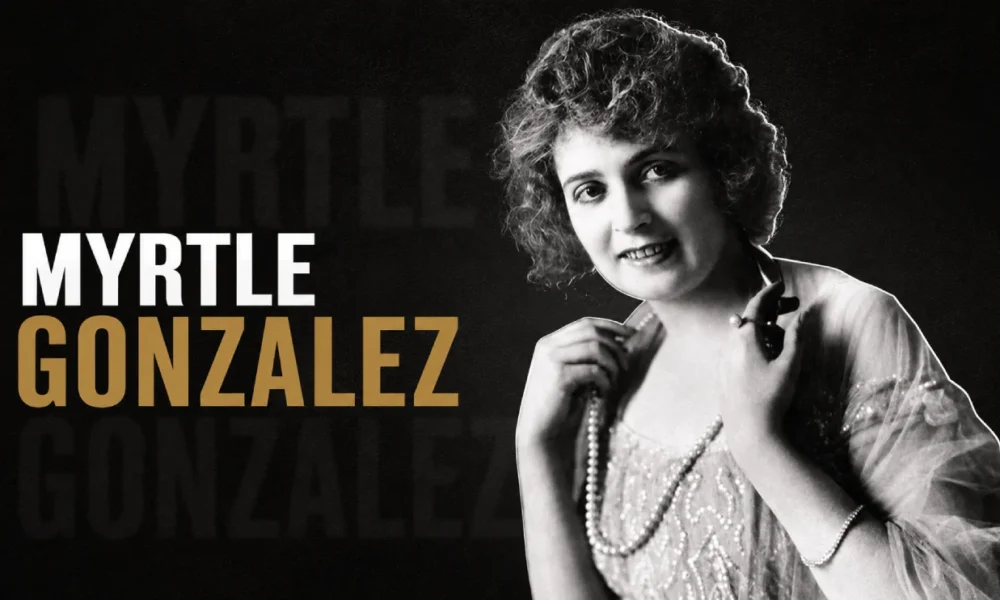
Myrtle Gonzalez (1891–1918) was an American silent film actress who appeared in nearly 80 films over a career spanning just five years. Of Mexican and Irish descent, she is recognized as one of Hollywood’s first Latina and Hispanic movie stars. Working primarily with Vitagraph Studios and later Universal, she built a reputation playing bold, outdoorsy heroines at a time when most female characters on screen were passive figures.
Table Of Content
Her life was cut short at age 27 during the 1918 Spanish flu pandemic, and much of her work has been lost to time — but her contribution to early American cinema endures.
Quick Facts
| Full Name | Myrtle Gonzalez |
| Born | September 28, 1891 — Los Angeles, California |
| Died | October 22, 1918 — Los Angeles, California (age 27) |
| Heritage | Mexican (father) and Irish (mother) |
| Active Years | 1913–1917 |
| Film Count | Approximately 80 films (66 were one- and two-reel shorts) |
| Studios | Vitagraph Company of America, Universal Studios |
| Spouses | J. Parks Jones (m. 1910; div. 1914), Allen Watt (m. 1917) |
| Children | 1 — James Parks Jones Jr. |
| Notable Nickname | “The Virgin White Lily of the Screen” |
| Cause of Death | Spanish flu (1918 pandemic) |
Early Life in Los Angeles
Myrtle Gonzalez was born on September 28, 1891, in Los Angeles, California, into a family that bridged two cultures. Her father, Manuel George Gonzalez, came from a Hispanic Californio family with deep roots in Mexican California — a lineage that predated the American takeover of the territory. Her mother, Lillian L. Cook, was the daughter of Irish immigrants and a former opera and popular singer. Myrtle grew up with two siblings: a sister, Stella, and a brother, Manuel Jr.
From childhood, Myrtle displayed a natural dramatic talent and a strong soprano voice inherited from her mother. She sang in church choirs, local concerts, and charity benefits across Los Angeles. Her mother actively encouraged her artistic development, and by her teenage years, Myrtle was appearing in juvenile stage roles alongside established performers like Fanny Davenport and Florence Stone. Theater was her first love, and for a time, it seemed like the concert stage might be her destination.
But Los Angeles was changing. In the early 1910s, the fledgling motion picture industry began migrating west from New York, drawn by Southern California’s diverse landscapes, abundant sunlight, and cheap real estate. For a young stage actress already living in the city that was about to become the world’s filmmaking capital, the timing was extraordinary.
Entering the Film Industry
Gonzalez’s transition from stage to screen happened at a moment when the film industry itself was still figuring out what it was. Studios operated with minimal infrastructure. Films were shot quickly, often in days. Editing techniques were basic. Lighting was primitive and physically punishing — early film stock demanded intense illumination from hot studio lights or direct sunlight, and performers worked long hours under those conditions without the benefit of monitors or playback to review their work.
For stage-trained actors, this shift was disorienting. The exaggerated gestures and broad expressions that carried to the back row of a theater looked absurdly overwrought on camera. The lens captured everything — every flicker of an eyelid, every tense shoulder, every false moment. Actors who couldn’t recalibrate their technique to this new medium often failed.
Gonzalez adapted quickly. Directors noticed her ability to convey complex emotion through subtle facial expression and controlled body language. She understood instinctively that the camera didn’t need grand gestures — it needed truth. Her theater background gave her a solid foundation in physical storytelling, which was essential in an era when dialogue was limited to brief title cards. Pacing, movement, and presence carried entire scenes. She could hit her marks precisely and reproduce performances across multiple takes with consistency — critical skills when editing technology offered little room for error.
Vitagraph Studios and the Rise of an Outdoorsy Heroine
The Vitagraph Company of America was one of the most prolific and important studios of the early silent era. At its peak in the early 1910s, it was considered the largest film producer in the world, operating out of Brooklyn before expanding to California. Vitagraph specialized in short films and serials, and it signed Gonzalez in 1913 — the same year she made her screen debut in The Yellow Streak.
Her early roles at Vitagraph were small, but she quickly built momentum. Between 1913 and 1914, she appeared in five films opposite William Desmond Taylor, a popular actor who would later become a director and whose mysterious 1922 murder remains one of Hollywood’s most infamous unsolved cases. Their collaborations included the comedy-drama Her Husband’s Friend, the dramas Tainted Money, The Kiss, and Captain Alvarez, and the comedy Millions for Defence. Of these, The Kiss (1914) is one of the few surviving records of Taylor performing in front of the camera.
Gonzalez’s defining role came in 1915 when she starred as Enid Maitland in The Chalice of Courage, a six-reel feature-length drama opposite William Duncan. It was one of the most ambitious productions she had been part of, and it solidified her reputation. A magazine writer at the time called her “The Virgin White Lily of the Screen” — a nickname she reportedly valued above all others she received during her career.
What set Gonzalez apart from her contemporaries was the type of character she inhabited. While many women in 1910s cinema were cast as passive romantic interests, distressed damsels, or femme fatales — reflecting the narrow stereotypes available to female characters, particularly Latina women — Gonzalez consistently played strong, resourceful women who thrived in the wilderness. Her heroines lived in forests, braved snowstorms, and faced adversity with determination rather than despair. In one notable production, she reportedly acted in three feet of snow. These weren’t delicate, parlor-room women. They were practical, resilient, and physical.
Filmography: Key Films
The following table includes notable titles from Gonzalez’s career. Many of her films have been lost; this list reflects the most documented works.
| Title | Year | Studio | Notes |
|---|---|---|---|
| The Yellow Streak | 1913 | Vitagraph | Film debut |
| Her Husband’s Friend | 1913 | Vitagraph | With William Desmond Taylor |
| Tainted Money | 1914 | Vitagraph | With William Desmond Taylor |
| Millions for Defence | 1914 | Vitagraph | Comedy; with William Desmond Taylor |
| The Kiss | 1914 | Vitagraph | With William Desmond Taylor; one of few surviving records of Taylor acting |
| Captain Alvarez | 1914 | Vitagraph | With William Desmond Taylor |
| The Level | 1914 | Vitagraph | Released November 23; Gonzalez plays Carolyn Johnson |
| The Chalice of Courage | 1915 | Vitagraph | Six-reel feature; her most acclaimed role as Enid Maitland |
| The End of the Rainbow | 1916 | Vitagraph | Bold heroine living in nature |
| The Secret of the Swamp | 1917 | Universal | Outdoorsy heroine in wilderness setting |
| The Girl of Lost Lake | 1917 | Universal | Cemented her outdoorsy heroine persona |
| The Mexican | 1918 | Universal | Posthumously honored by Photoplay Magazine in 1919 with a Bronze Plaque |
Across her career, she appeared in approximately 80 films, 66 of which were one- and two-reel shorts running 10 to 20 minutes. This pace was not unusual for the silent era — studios operated like factories, sometimes producing multiple films per week — but it demanded extraordinary stamina and versatility from performers.
The Move to Universal
After several productive years at Vitagraph, Gonzalez moved to Universal Studios, where she continued to develop the type of character that had made her name: the outdoor heroine. Films like The Secret of the Swamp and The Girl of Lost Lake placed her in natural landscapes — forests, lakes, and wilderness — where her characters had to adapt and survive. These weren’t merely adventure stories; they were a deliberate counterpoint to the urban melodramas that dominated the era.
It was at Universal that she met Allen Watt, who was working as an assistant director. Their professional relationship eventually became personal, and the two married on December 1, 1917, in Los Angeles.
Personal Life
Gonzalez’s personal life was more turbulent than her public image suggested. She married her first husband, J. Parks Jones, on August 25, 1910. The couple had one son, James Parks Jones Jr., before Gonzalez filed for divorce in November 1914, charging Jones with desertion. She was raising a young child while simultaneously building one of the busiest acting careers in early Hollywood.
Her marriage to Allen Watt came near the end of her career and her life. By the time they wed in December 1917, the United States had entered World War I, and Watt was serving as an officer in the U.S. Army, stationed at Camp Lewis near Tacoma, Washington. Gonzalez’s health proved too fragile for the Pacific Northwest climate, and Captain Watt was placed on the Army’s retirement list so he could return her to Southern California. He went back to work at Universal, this time as a director.
Gonzalez retired from screen work after the marriage. She was 26 years old. She would not live to see 28.
Death During a Pandemic
Myrtle Gonzalez died on October 22, 1918, at her parents’ home at 908 West Thirtieth Street in Los Angeles. She was 27 years old. The cause was the Spanish flu — the catastrophic influenza pandemic that swept the globe between 1918 and 1919.
The scale of that pandemic is difficult to overstate. It infected at least 25 million Americans — roughly one-quarter of the entire population — and killed approximately 675,000 people in the United States alone, surpassing the American death toll of World War I. Hospitals were overwhelmed. Public health systems, left largely to state and local authorities with wildly uneven resources and no coordinated federal response, struggled to manage the crisis. Newspapers were saturated with pandemic coverage and war news.
Into this chaos, the death of a 27-year-old silent film actress barely registered. There were no major obituaries. The entertainment press, operating under wartime paper restrictions and competing with a global health emergency, gave her passing little attention. It was a quiet end for someone who had appeared on screens across the country just a year earlier.
Her husband, Allen Watt, survived her. He continued working at Universal through the 1920s, directing and acting in several films.
The Lost Films Problem
One of the defining tragedies of Gonzalez’s legacy is how little of her work survives. An estimated 75 percent of all American silent films are considered lost — destroyed by fire, deterioration, deliberate studio disposal, or simple neglect over the decades. Film stock from the era was often nitrate-based, highly flammable, and chemically unstable. Studios that saw no commercial value in old short films frequently junked them to recover storage space or silver content.
Of Gonzalez’s approximately 80 films, only a fraction are known to exist in any archive. The Library of Congress has preserved several of her works, ensuring they are not entirely erased from the historical record. But the majority of what she created — and the full range of her performances — can no longer be seen. For film historians, this makes her surviving work exceptionally valuable, and it makes reconstructing the complete arc of her career an ongoing archival challenge.
If you’re interested in accessing what remains, the Library of Congress and the UCLA Film and Television Archive are the primary repositories for silent-era American film. The Internet Archive and the National Film Preservation Foundation also maintain digitized collections. For academic research, digitized newspaper archives like Chronicling America and Newspapers.com hold contemporary reviews, advertisements, and publicity materials from the 1910s that offer indirect evidence of her work even where the films themselves are gone.
Legacy and Representation
Gonzalez’s significance rests on three foundations.
She helped define what screen acting could be
In an era when most performers treated the camera like a distant theater audience, Gonzalez demonstrated that film demanded its own grammar of performance — subtler, more internal, more trusting of the close-up. Her naturalistic style was part of a broader shift in 1910s cinema toward believable, emotionally grounded performances. The actors who came after her inherited a clearer understanding of what “good screen acting” meant because performers like her had shown the way.
She was a Latina presence in an industry built on narrow stereotypes
During the 1910s, the only Latin characters most American audiences saw on screen were “greasers” — Mexican men cast as mustachioed villains in Westerns — and seductive, untrustworthy femme fatales. These roles reflected and reinforced the era’s racism, rooted in the mythology of Manifest Destiny that cast Mexicans and Indigenous people as obstacles to American progress. Gonzalez didn’t fit either stereotype. She played determined, honorable women. She was proud of her Hispanic heritage and never hid it, even as the industry around her offered few roles for people who looked like her. Alongside fellow Latina actress Beatriz Michelena — who was producing and starring in her own films during the same period — Gonzalez proved that Latin performers could carry mainstream American films without resorting to caricature.
Her career is a window into how early Hollywood actually worked
The pace — roughly 80 films in five years — reveals an industry that was fast, demanding, and physically grueling. Actors completed films in days. Studios churned out one- and two-reel shorts at industrial speed. Gonzalez’s productivity wasn’t exceptional for the era, but it illustrates the reality behind the glamour: silent filmmaking was labor, and the performers who sustained it did so under conditions — primitive technology, extreme lighting, no playback, no safety nets — that would be unrecognizable to modern actors.
In 2022, Google honored her with a commemorative Doodle on November 23 — the anniversary of the release of The Level (1914). The illustration, created by Mexican-born Pixar artist Ana Ramirez Gonzalez, depicted Myrtle bundled in winter gear against a snowy landscape, a nod to the outdoorsy heroines she made famous. The tribute brought renewed attention to a figure who had been largely forgotten outside of film history circles.
TCM (Turner Classic Movies) has also recognized her during Hispanic Heritage Month programming, placing her at the start of a lineage that includes Emile Kuri, Jose Ferrer, Rita Moreno, and subsequent generations of Hispanic filmmakers and performers.

No Comment! Be the first one.